Details: NGC
7727 was discovered by the famous German-British astronomer
William
Herschel on November 27, 1785. It is only 4.7 by 3.5
arcminutes in size as seen from earth, or one tenth the apparent
size of the full moon. It has an
apparent magnitude of 10.6 or about 50 times fainter than
the faintest star visible to the human eye. NGC 7727 is between
90 to 100 million
light years
away, therefore when light left this galaxy, only dinosaurs and
no humans, ruled Earth. It is about 60,000 light-years across,
but leaves traces of billions of stars behind at distances
greater than that.
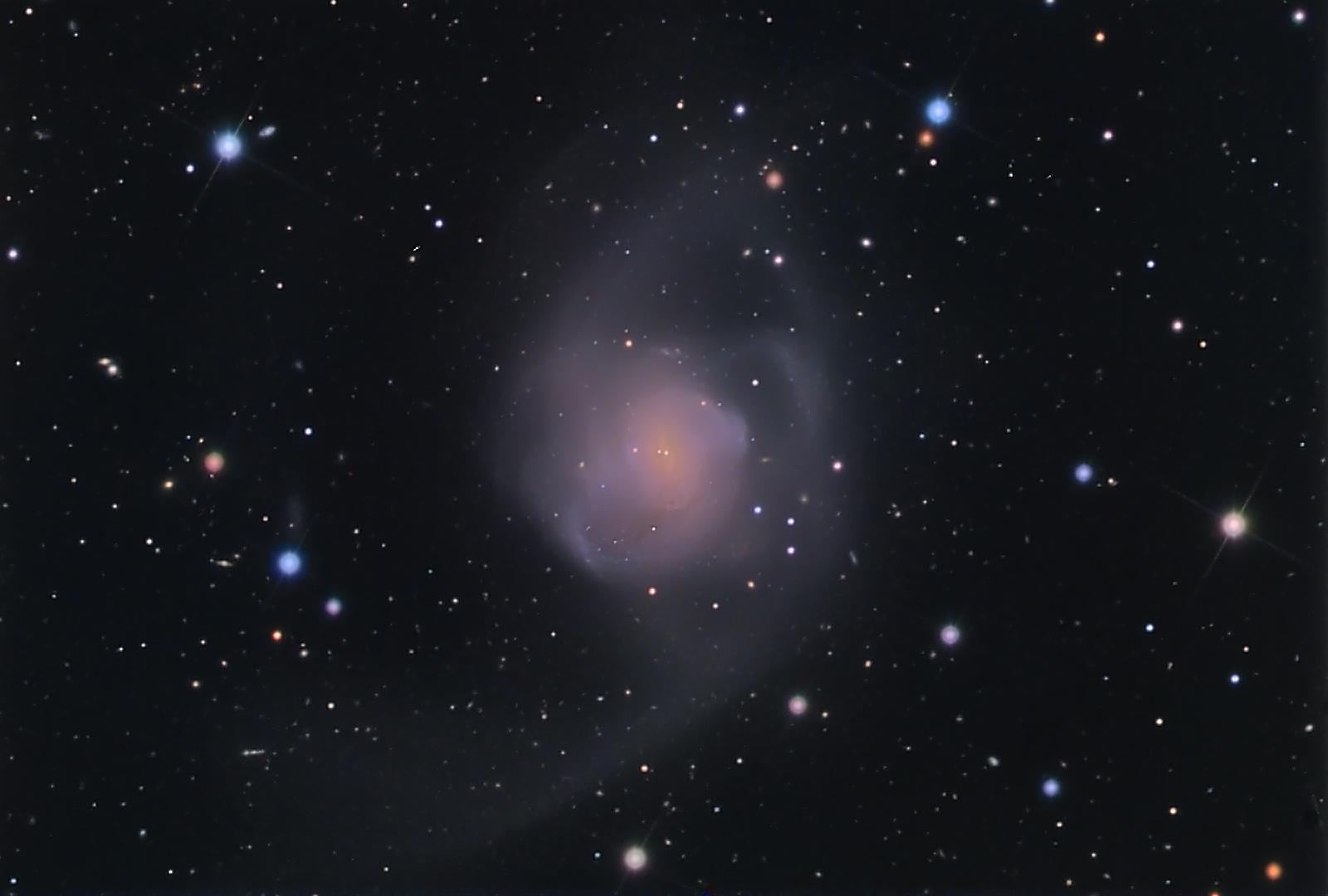
Galaxies Just Merged: NGC 7727
is not a normal galaxy, but a peculiar lenticular galaxy and two
separate galaxies that have already merged. The peculiar galaxy
classification means it is of unusual size, shape or
composition, and only 5-10% of galaxies belong to this class.
Lenticular denotes a type of galaxy classification that lies
between an
elliptical galaxy (E) class having no galaxy spiral arms and
a
spiral galaxy
(S) class with spiral arms. There is clear evidence of
this merger in that the distorted outer structure is clearly
loops of material caused by the galaxies passing each other
multiple times. Also there are faint tidal features left over
from the gravitational distortion between galaxies and a very
chaotic stellar distributions remains compared to galaxies that
have not recently merged. The merger is believed to have
happened about 1-2 billion years ago when life was first forming
on planet earth, but relatively recent in galactic timescales!
Two Supermassive Black Holes: NGC 7727 is a well
known somewhat unique galaxy among astronomers in that the
remnants of its two galactic nuclei, each contain a
supermassive black hole or (SMBH) nearing the end of their
merger. SMBHs are the most massive type of black hole with a
mass on the order of hundreds of thousands to billions of times
the mass of our
Sun
(
M☉).
Note that the center of all black holes are a
gravitational singularity, meaning they are all
infinitesimally small and with infinite density. Black holes,
however, do vary in mass from about 3 solar masses, to billions
of solar masses. Scientists measure the size of black holes not
by the size of the singularity, which is zero and thereby
meaningless, but by the size of the
event
horizon, or the boundary at a distance from the black hole
singularity beyond which no signal or “event” can ever reach an
observer. This is due to the gravitational well created by the
black hole beyond which no matter or light can escape! The event
horizon diameter of a 3 solar mass black hole is about 9
kilometers, meaning the mass of 3 of our Suns fitting into the
size of a small city! The event horizon diameter of the largest
black hole discovered is 590 billion kilometers, meaning the
mass of 100 billion Suns fitting into 100 times the distance
between the Sun and Pluto, still a small size of only 1/70
th
the distance to our Sun’s nearest stellar neighbor!
The first of the two super massive black holes in NGC 7727 contains
about 154 million solar masses. This is the dominant nucleus
here visible at the center of the above image as a bright yellow
core. The second super massive black hole in comparison is only
a pale 7 million solar masses and also visible here to the left
and slightly above the dominant one. It is also one of the
smallest SMBH nuclei ever measured directly. These SMBHs are
only separated by 1600 light-years, making them the closest
known pairs of SMBHs known. In about 250 million years the two
black holes will merge to form a 160 million solar mass black
hole and produce some of the greatest most powerful
gravitational waves, however at such a great distance the
effect on earth will be miniscule.
As the galaxies
merge, they follow the trails of their SMBHs to form galaxy
tendrils, loops, or shells of material left behind by the
gravitational interaction. These loops visible and annotated
here contain billions to tens of billions of suns each!
A Dead Galaxy: The merger of any two galaxies will likely
never cause two stars to collide due to the vast distances
between stars. However, these mergers do disrupt normal galaxy
behavior in star formation activity, availability of
interstellar gas and dust, and hence stellar population
distribution. In NGC 7727, there is now very little star
formation, almost no gas or dust for future star formation since
it was mostly expelled form the galaxy, and hence all the stars
are of older population. This will of course change over time as
older stars die and create new gas sources for future stars.
Also the scattered and distributed interstellar gas and dust
will eventually begin to coalesce and form new gas sources.
Astronomers love to study galaxies like NGC 7727
as textbook examples of galactic mergers, transforming spiral
galaxies into lenticular and eventually elliptical galaxies.
Also NGC 7727 demonstrates how supermassive black hole binary
systems form and what galaxies look like between the final
galactic merger and final black hole merger. Studies by the
Hubble Space Telescope show a well resolved SMBH double
nucleus, however studies at multiple wavelengths of light show
very little activity in the merged galactic nucleus despite the
ongoing merger between the black holes.
Annotations: In the image above, hover a mouse or curser over the image
to show annotations of NGC 7727, with several enlarged insets
identifying interesting features! Starting at the top and left
of the image are two distant galaxies likely 100s of millions of
light years away. Proceeding downward are the remnant of the
early encounter between the two galaxies. On the right side of
the image is an inset showing the double nucleus and identifying
each of the super massive black holes. Finally, in the center is
a path marked where the smaller, less massive secondary galaxy
looped around the dominant galaxy. Of course, due to gravity the
galaxies actually revolved around each other, however the
barycenter or middle point of this revolving was much closer to
the central dominant galaxy.
Below Images: The
image below is the same image as above but processed to remove
all stars. Since most of the stars in the image are in our own
galaxy, this is what the galaxy would appear outside of our
galaxy, if no stars existed along our line of sight. Using a
mouse to hover over the image brings all the stars back. In the
second image below is a zoomed in version of NGC 7727. Hovering
over the image makes the stars disappear. Finally, the last
image below is a comparison with the current generation of
processing to my old generation 1 processing. This is the same
data, same set of preprocessed images, but with improved
processing techniques. Hovering the mouse over the image fades
from the old image to the new processing!
Object Statistics: Constellation: Aquarius, Right Ascension: 23
h
39
m 52
s, Declination: -12° 17' 34”,
Apparent Magnitude: 10.6, Size: 4’.7 x 3’.5 (60,000 light-years
diameter), Distance 89-100 million light-years from Earth.