Overview: Messier 100 (also known as NGC 4321) is a
breathtaking
spiral
galaxy residing within the delicate northern
constellation
Coma
Berenices — “Berenice’s Hair,” a faint but storied star
pattern tied to ancient legend. Discovered in the 18th century,
this region of sky may appear subtle to the unaided eye, yet it
harbors one of the most magnificent spiral systems in the nearby
universe. Messier 100 stands as a near-perfect example of a
grand design spiral galaxy, with two sweeping, symmetrical
arms unfurling gracefully from a luminous core. These arms are
richly studded with star-forming regions and glowing clusters,
giving the galaxy a vibrant, almost living appearance. Unlike
chaotic or distorted galaxies shaped by violent encounters,
Messier 100 exhibits remarkable order and symmetry — a cosmic
masterpiece sculpted by the steady hand of
gravity over
immense spans of time.
Details: Messier 100 was
discovered on March 15, 1781 by the prolific French astronomer
Pierre
Méchain and later cataloged by
Charles
Messier in his famous list of nebulae and star clusters.
Through a telescope, the galaxy spans roughly 7.4 by 6.3
arcminutes
— about one quarter the apparent diameter of the full Moon —
making it a moderately sized but challenging object for amateur
observers under dark skies. Shining at an apparent magnitude of
approximately 9.4, Messier 100 is beyond naked-eye visibility
but becomes a rewarding target in mid-sized telescopes. Located
about 55 million
light-years
from Earth, it stretches roughly 160,000 light-years across,
making it somewhat larger than our own
Milky Way.
A Grand Design Spiral: Messier 100 is classified
as an intermediate spiral galaxy (SABbc), meaning it possesses a
weak or partial central
bar
structure along with well-defined spiral arms. Its arms are
among the most symmetric known, tracing elegant
logarithmic spirals outward from the nucleus. These arms are
rich in bright blue star clusters and pinkish nebulae — regions
of active
star formation where new stars are born from collapsing
clouds of gas and dust. The structure of these arms is shaped by
density waves propagating through the galactic disk,
organizing material into coherent patterns under the influence
of the galaxy’s rotating
gravitational field.
Galactic Structure and
Dynamics: The central region of Messier 100 contains a
bright, compact nucleus surrounded by a slightly elongated inner
structure that hints at a weak bar. Like most large galaxies, it
almost certainly harbors a central
supermassive black hole, though it is not strongly active.
The galaxy exhibits vigorous star formation throughout its
spiral arms, particularly in knots and segments where gas
density is highest. Observations from space-based instruments
such as the
Hubble Space Telescope have revealed intricate
dust lanes
threading through the arms and a wealth of young stellar
populations. Messier 100 has also hosted several observed
supernovae,
underscoring its ongoing stellar evolution and dynamic internal
processes.
Environment in the Virgo Cluster: Messier 100 resides within the vast
Virgo
Cluster, the nearest large cluster of galaxies to the Local
Group. This densely populated region contains thousands of
galaxies interacting through mutual gravitational influence.
While Messier 100 itself maintains a relatively undisturbed and
symmetric appearance, subtle
tidal
interactions with neighboring galaxies in the cluster may
contribute to sustaining its spiral structure and triggering
bursts of star formation. Deep images of the surrounding field
reveal numerous companion galaxies and distant background
systems, adding depth and context to this already remarkable
object.
A Luminous Spiral in Motion: Messier 100
represents a vivid snapshot of galactic evolution in progress.
Its orderly spiral pattern, active star-forming regions, and
balanced structure illustrate how galaxies can evolve gracefully
even within crowded environments like the Virgo Cluster. Systems
like Messier 100 provide astronomers with crucial insight into
how spiral arms persist, how stars are born on galactic scales,
and how large galaxies maintain their structure over billions of
years. In many ways, it offers a glimpse into processes that may
also shape the long-term future of our own Milky Way.
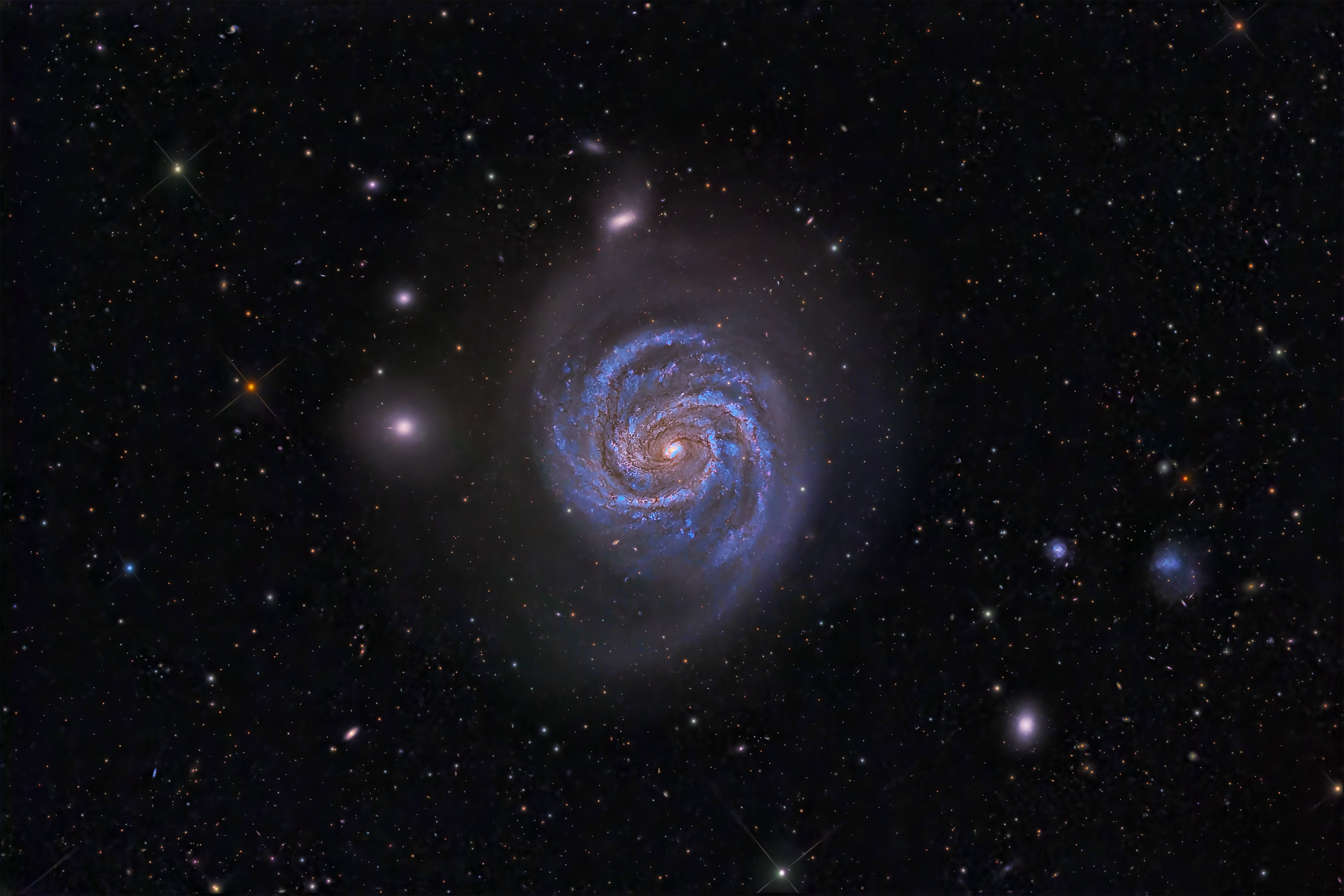
Annotations. In the image above, hover a mouse or cursor
over the image to reveal annotations highlighting the bright
central nucleus, the sweeping symmetric spiral arms, and
numerous star-forming regions scattered along the arms. Fine
dust lanes can be seen tracing dark filaments across the
luminous disk, while faint background galaxies pepper the field
beyond Messier 100, offering a striking sense of cosmic depth.
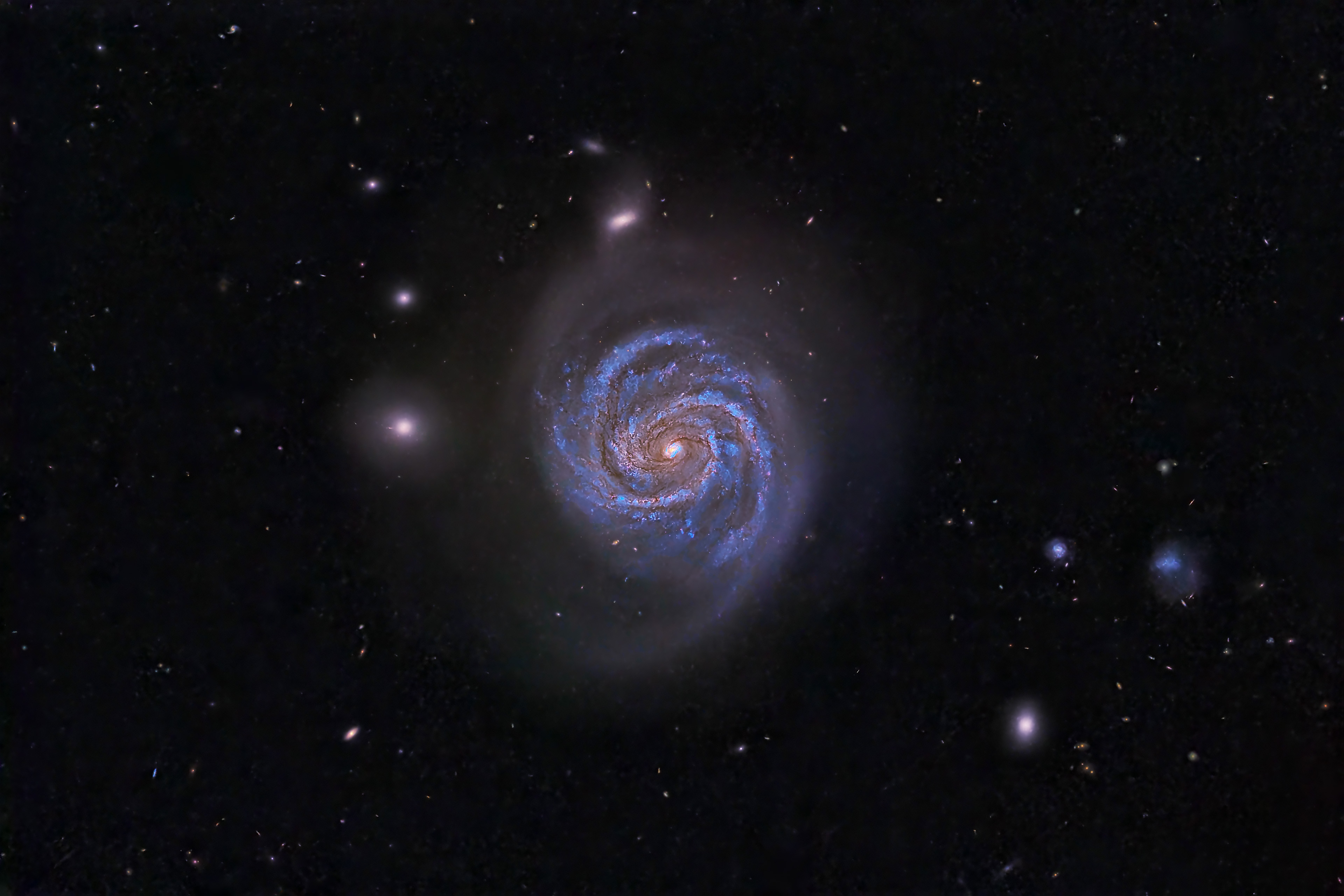
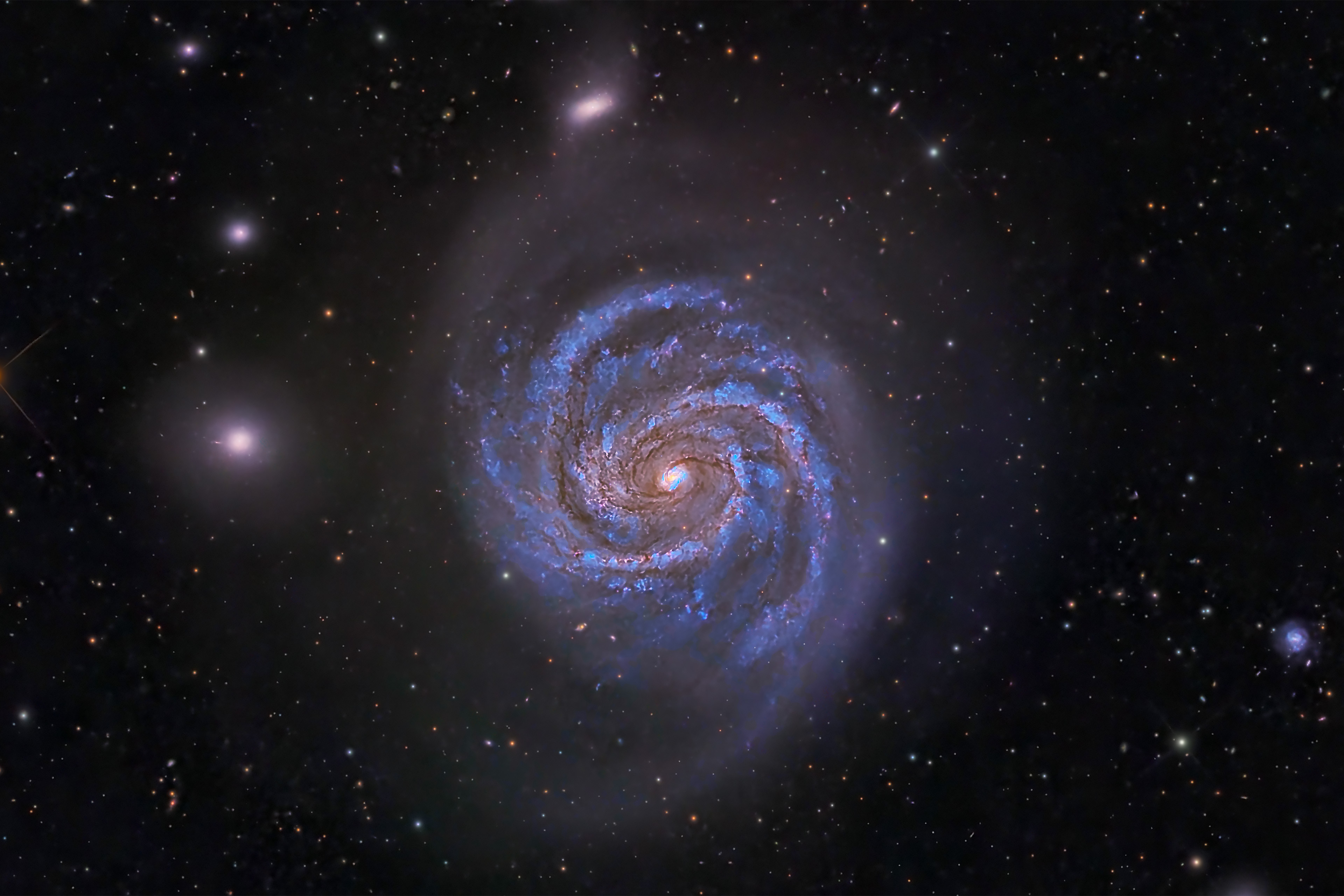
Below Images: The image below is the same dataset
processed to reduce the impact of foreground stars from our own
galaxy, revealing a cleaner view of Messier 100’s delicate
spiral structure. Hovering over the image restores the
foreground stars. An additional englarged comparison image follows.
Object Statistics: Constellation: Coma Berenices, Right
Ascension: 12
h 22
m 54
s,
Declination: +15° 49′ 21″, Apparent Magnitude: 9.4, Size: 7′.4 ×
6′.3 (~160,000 light-years diameter), Distance: ~55 million
light-years from Earth.