Details: Cataloged as the 61st object in the famous
Messier
Catalogue, this galaxy was first recorded in 1779 by Italian
astronomer
Barnaba
Oriani, who initially suspected he might be seeing a comet.
Charles
Messier later confirmed it as a permanent deep-sky object,
cementing its place in astronomical history. Messier 61 lies
roughly 52 million
light-years
from Earth and spans close to 100,000 light-years in diameter —
placing it in the same general size class as our own
Milky Way Galaxy.
Through a telescope it appears about 6.5 by 5.8
arcminutes
across, presenting a softly luminous oval with a brighter
central region that gradually resolves into spiral structure in
larger apertures.
A Face-On Starburst Spiral:
Messier 61 is classified as an intermediate barred spiral galaxy
(SAB(rs)bc), meaning it possesses a weak central bar embedded
within a richly structured disk. What makes M61 especially
valuable to astronomers is its orientation: we see it almost
perfectly face-on. This fortunate alignment exposes the full
architecture of its spiral arms, which are studded with bright
blue star-forming regions and threaded by dark dust lanes. NASA
observations emphasize that the galaxy is undergoing unusually
vigorous
starburst activity, rapidly converting gas into new
generations of stars through the processes of
star
formation. The result is a galaxy that appears to be living
fast by cosmic standards, with energy and motion evident across
its entire disk.
The Supernova Factory: Few
nearby spirals rival Messier 61’s explosive résumé. Astronomers
have recorded six
supernovae
within this single galaxy - an unusually high number that
reflects its elevated rate of massive star formation. In
starburst environments, short-lived massive stars form in
abundance and then end their lives in violent core-collapse
explosions governed by the physics of
stellar evolution. Each supernova briefly outshines billions
of ordinary stars, leaving behind expanding shock waves that
further stir the galactic medium. Because of this remarkable
activity, M61 has become an important laboratory for studying
stellar death and chemical enrichment in spiral galaxies.
Galactic Core and Dynamics: At the heart of Messier
61 lies a dense, luminous nucleus embedded within a bright
central bulge of older yellow stars. Like most large spirals,
the galaxy almost certainly hosts a central
supermassive black hole, though it is not classified as a
highly active galactic nucleus. The weak bar structure appears
to funnel gas inward under the influence of
gravity,
feeding both central star formation and the broader starburst
activity across the disk. Multi-wavelength observations from the
Hubble Space
Telescope reveal complex dust structures and clusters of hot
young stars, confirming that the galaxy is still dynamically
evolving rather than settling into quiet maturity through
long-term
galaxy
evolution processes.
Environment in the Virgo
Cluster: Messier 61 resides on the outskirts of the massive
Virgo
Cluster, a sprawling congregation of more than a thousand
galaxies bound together by
gravitation.
Although M61 is not in the cluster’s dense core, the surrounding
environment likely influences its evolution through past
galactic interactions and the broader
intracluster medium. Deep astronomical images of the region
reveal a rich background tapestry of far more distant galaxies,
giving observers a striking sense of cosmic depth when imaging
this field.
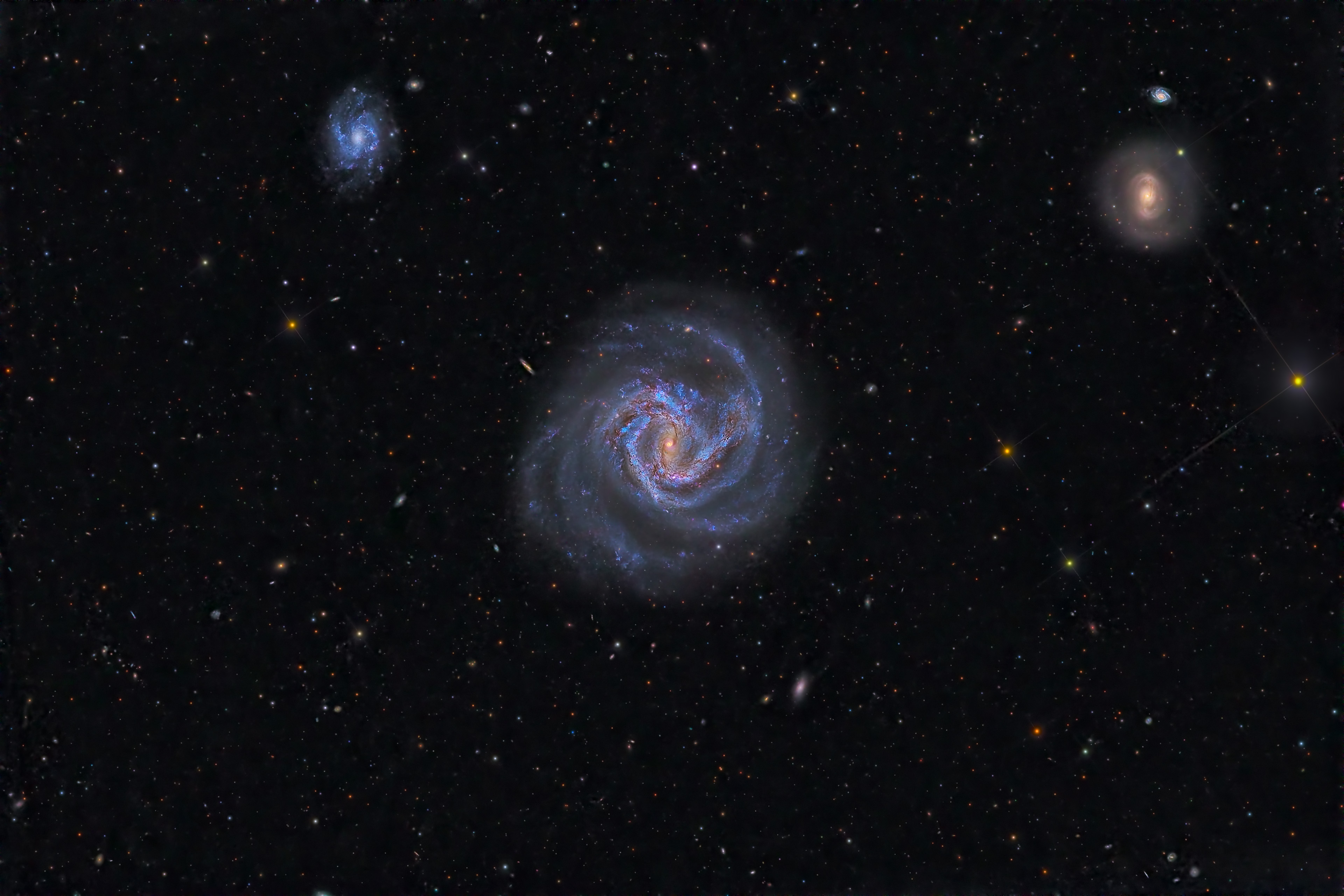
Nearby Field Companions — NGC 4301 and
NGC 4292: One of the delights of imaging Messier 61 is the
presence of two faint neighboring spirals in the same field of
view.
NGC 4301,
sometimes historically labeled NGC 4303A because of its
proximity to M61, is a delicate barred spiral that appears as a
much dimmer companion in deep exposures. It is itself a member
of the Virgo Cluster and shows scattered blue star-forming
regions along its loose arms. Nearby as well is
NGC 4292,
an even fainter spiral whose elongated disk hints at a subtle
ring-like structure. While these galaxies are not strongly
interacting with Messier 61, their presence enriches the visual
field and underscores the crowded nature of the Virgo region.
For astrophotographers, the trio forms an especially photogenic
composition: one dominant starburst spiral accompanied by two
ghostly background companions.
An Active Spiral in
Mid-Life: Messier 61 represents a galaxy in a relatively
energetic phase of its evolution. It is neither a chaotic merger
remnant nor a fully quiescent spiral. Instead, it occupies a
compelling middle ground where internal bar dynamics, abundant
gas, and cluster environment combine to sustain elevated star
formation. Systems like M61 provide astronomers with crucial
insight into how spiral galaxies grow, recycle material, and
gradually transform over billions of years.
Annotations. In the image above, hover a mouse or
curser over the image to show annotations of NGC 7727, with
several enlarged insets identifying interesting features!
Starting at the top and left of the image is NGC 4301.
Proceeding counterclockwise is a faint distant galaxy, followed
by enlargements of M61’s spiral arms. Next is another distant
galaxy as well as NGC 4292 mentioned above. Next, is distant
galaxy PGC 213977, too faint and small to be part of the NGC or
Messier catalogues, but large and bright enough to be included
in the PGC catalogue of over 1 million galaxies! Finally, back
at the 12 o’clock position is the central core of M61, showing
its tightly wound arms that extend almost all the way to the
central supermassive black hole.
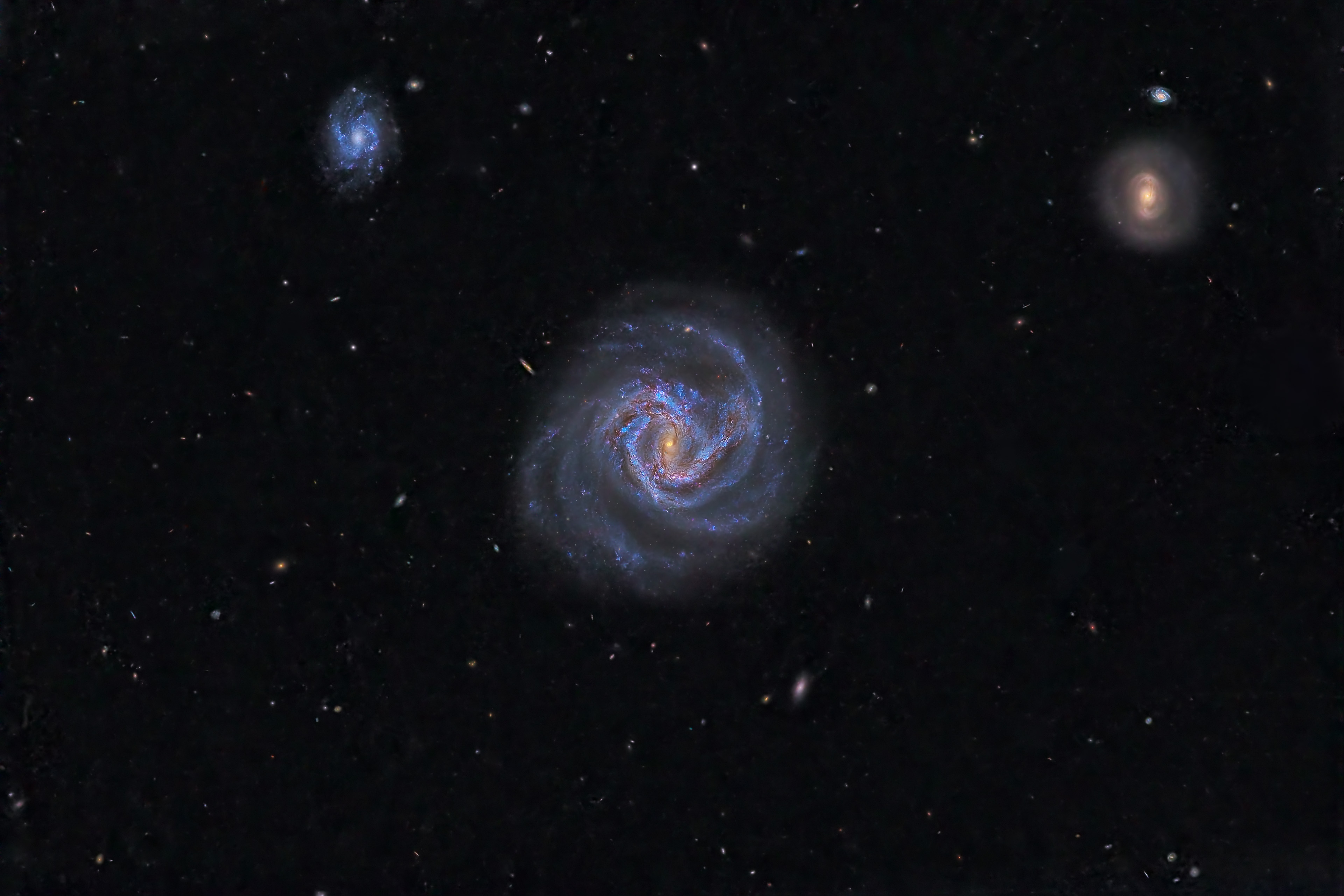
Below is the same image
of M61 but without stars, showing how it would appear
immediately outside our galaxy, since every individual star
visible in the image above is in our own Milky Way Galaxy.
Hovering a mouse over the image brings all the stars back.
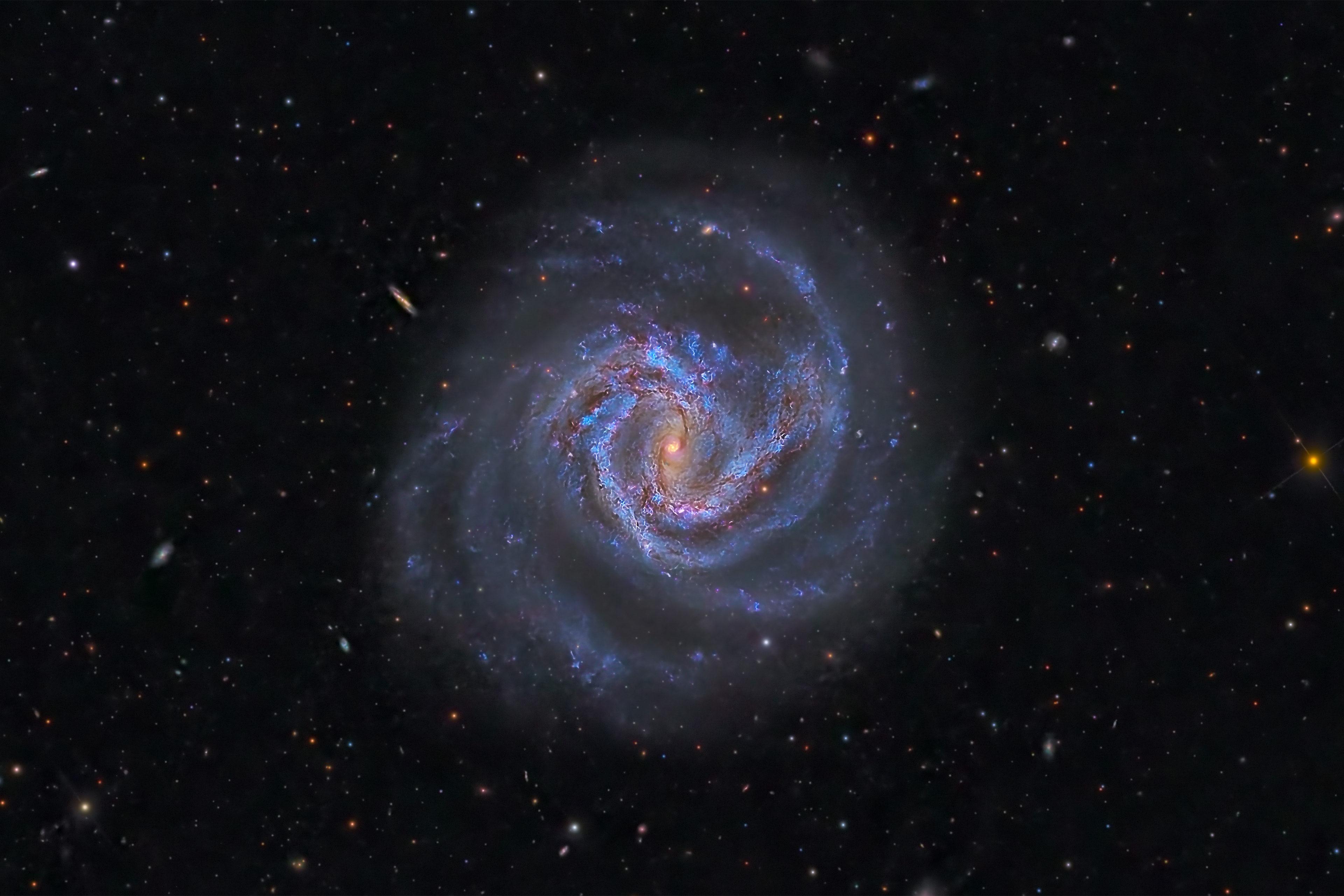
Finally, below is a zoomed in view of only M61 itself. Hovering
a mouse makes that view a starless one as well.
Object Statistics: Constellation: Virgo; Right Ascension: 12
h
21
m 55
s; Declination: +04° 28′ 25″;
Apparent Magnitude: ~9.7; Size: ~6′.5 × 5′.8 (~100,000
light-years diameter); Distance: ~52 million light-years from
Earth.