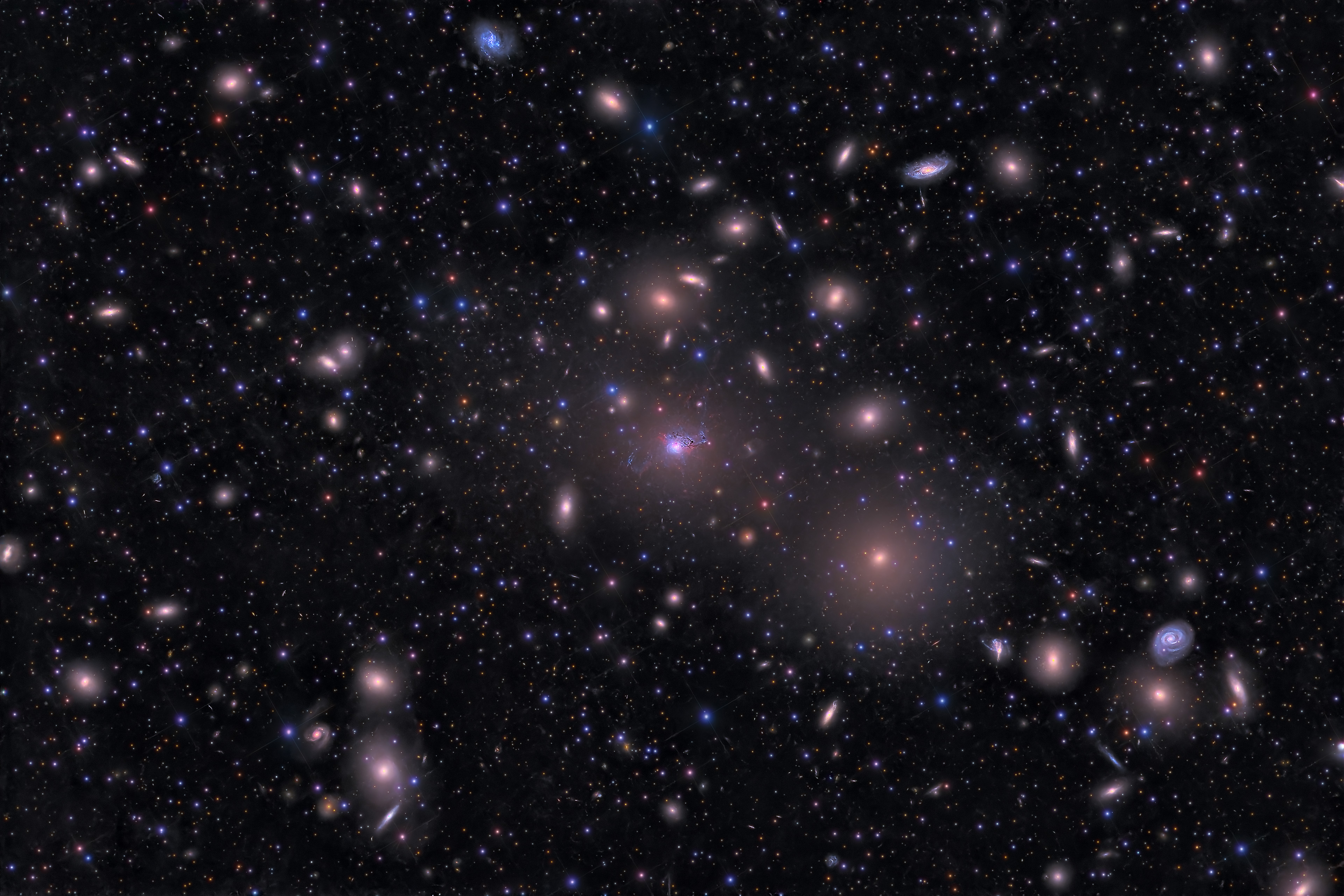
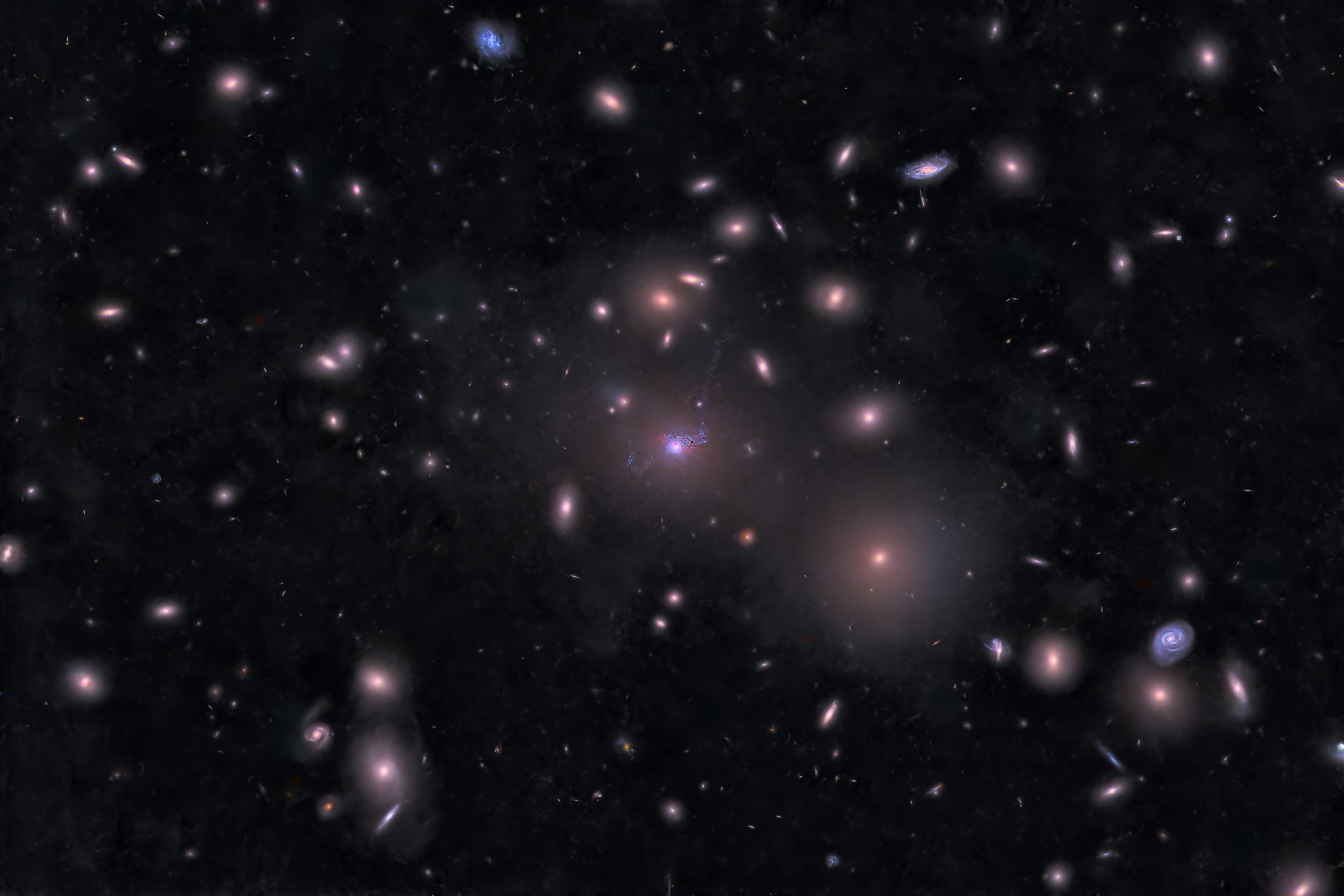
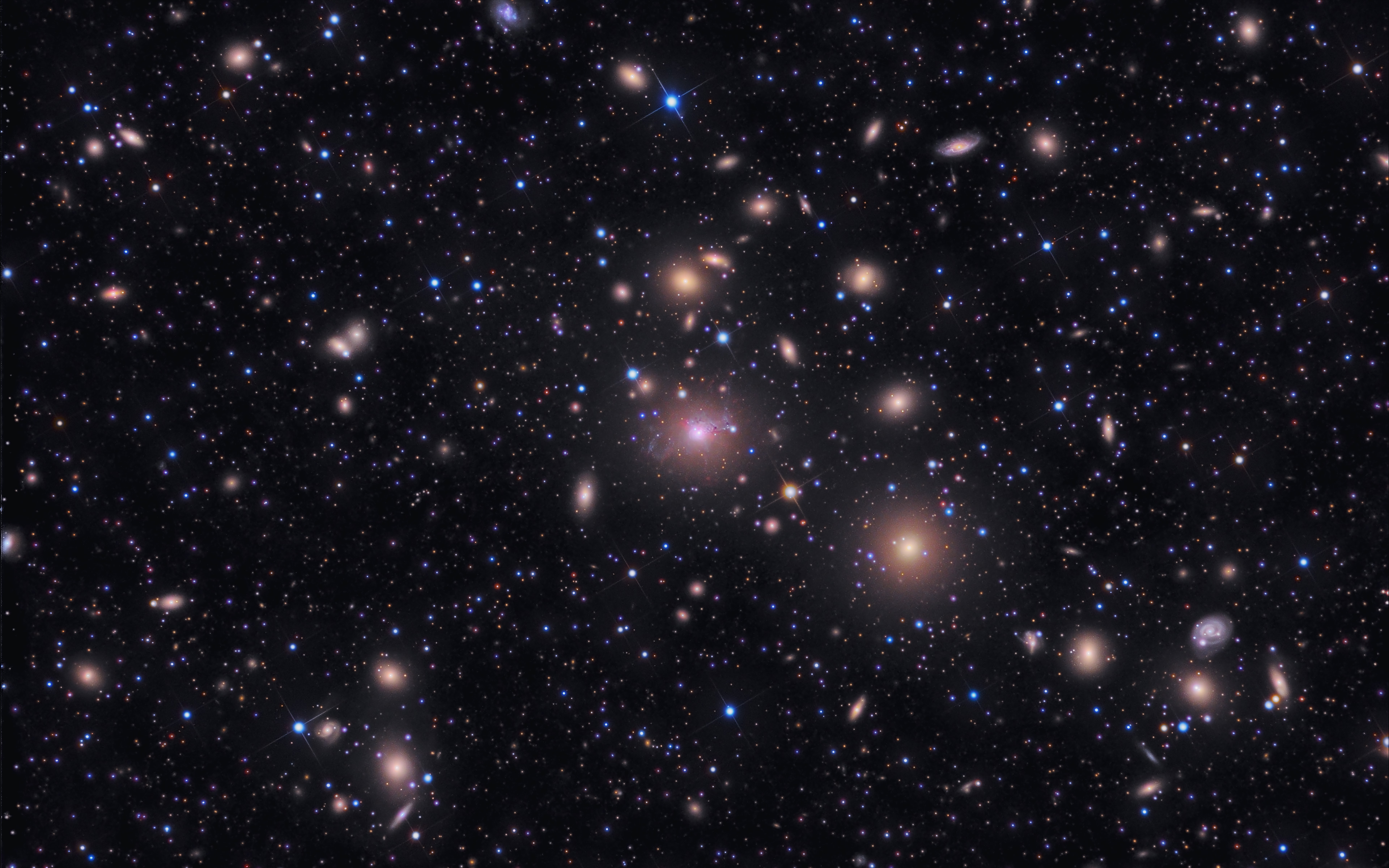
A Cluster within a Cosmic Web: The Perseus
Cluster, also cataloged as
Abell
426, is a massive
galaxy
cluster containing thousands of galaxies immersed in an
enormous reservoir of extremely hot
intracluster medium, or ICM. This gas is so hot—reaching
tens of millions of degrees—that it shines primarily in
X-rays rather
than visible light. In fact, Perseus is one of the brightest
galaxy clusters in the X-ray sky. Although individual galaxies
dominate the visible-light view, the vast majority of the
cluster's ordinary matter is not locked inside those galaxies.
Instead, much of it exists as this enormous, diffuse cloud of
hot gas filling the spaces between them, while an even larger
component of the cluster's total mass is believed to reside in
dark matter.
The Central Giant — NGC 1275: NGC 1275 is a
classic example of a giant central cluster galaxy, sometimes
described as a
central
dominant galaxy or cD galaxy. Unlike a typical
spiral
galaxy, with its rotating disk and prominent spiral arms, an
elliptical galaxy has a much more rounded or elongated
appearance and lacks the organized spiral disk seen in galaxies
like our Milky Way. NGC 1275 is enormous, extending well over
100,000 light-years across, and its enormous gravitational
influence makes it the natural centerpiece of the Perseus
Cluster.
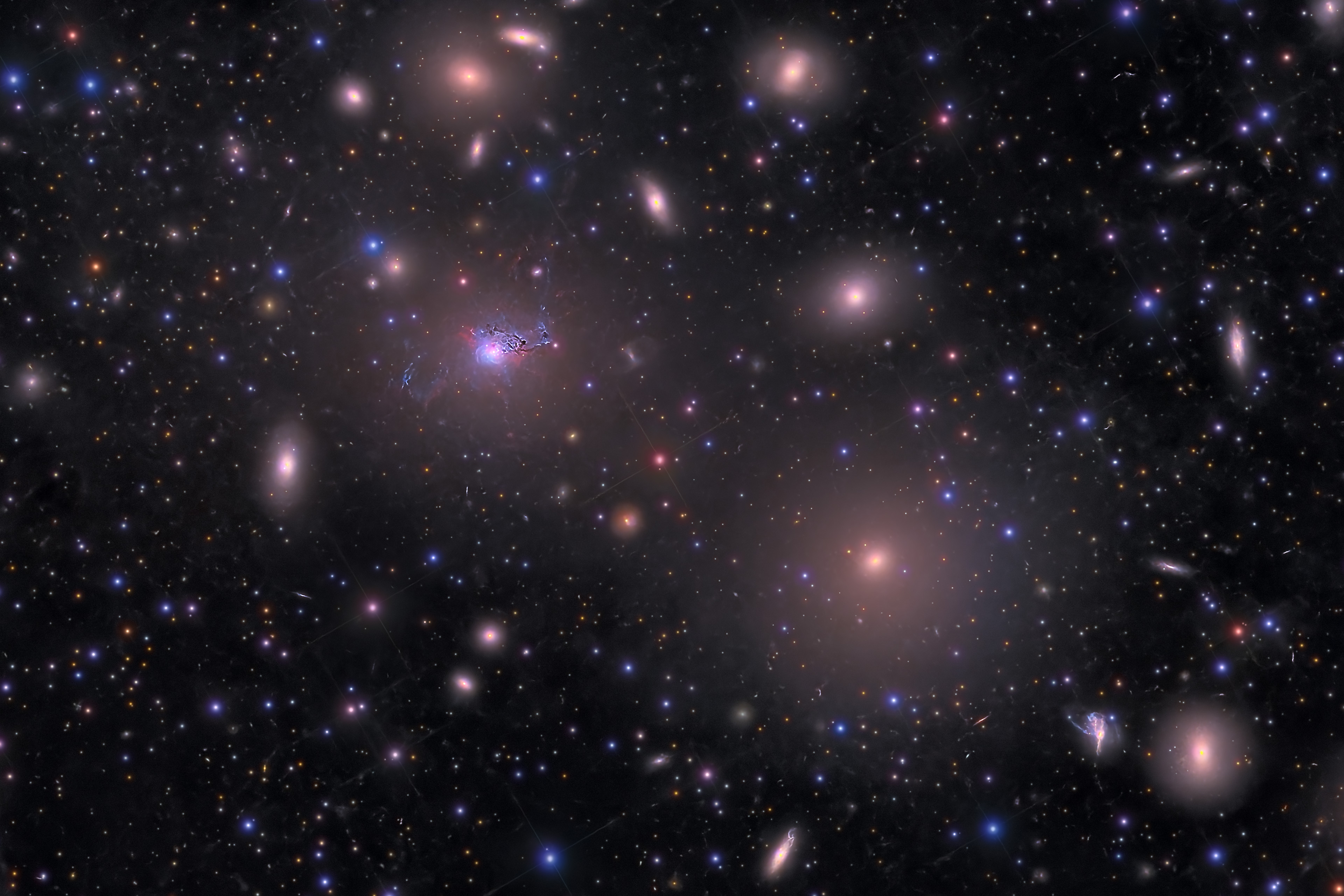
Why Does NGC 1275 Look Like It Is Exploding?
This is perhaps the most fascinating question raised by the
photograph. NGC 1275 really does look as though something has
erupted from its center. Long reddish tendrils appear to be
streaming outward in almost every direction, while the central
region seems surrounded by enormous bubbles or lobes. But NGC
1275 is not exploding like a star or undergoing a conventional
supernova
explosion. What we are seeing is the spectacular consequence of
an active galactic nucleus—an
active galactic nucleus, or AGN—powered by matter falling
toward the supermassive black hole at the galaxy's center.
The Black Hole at the Heart of the Storm: At the
center of NGC 1275 is a
supermassive black hole containing hundreds of millions of
times the mass of our Sun. Material drawn toward the black hole
does not simply disappear directly into it. Instead, gas can
form a rapidly rotating
accretion
disk, where friction, compression and magnetic processes
heat the material to enormous temperatures. Some of the energy
released by this process is channeled into powerful jets of
matter and energy launched away from the vicinity of the black
hole. These jets travel at speeds approaching that of light and
carry enormous amounts of energy into the surrounding cluster.
The Giant Radio Bubbles: The jets from NGC 1275
inflate enormous bubbles in the surrounding hot intracluster
gas. These are sometimes called
radio
bubbles because the relativistic particles and magnetic
fields within them produce intense
radio
emission. As the bubbles rise through the surrounding hot
gas, they push the X-ray-emitting material aside, creating
enormous cavities. When observations from the
Chandra X-ray Observatory and the
Very
Large Array are combined with visible-light images from the
Hubble Space Telescope, the relationship becomes
spectacularly clear: the radio-emitting lobes occupy cavities
carved into the surrounding X-ray-emitting gas.
The Giant Filaments: Perhaps the most remarkable structures in
the image are the long, narrow red filaments extending outward
from NGC 1275. These are not wisps of dust and they are not jets
themselves. They are enormous strands of relatively cool gas
embedded within the vastly hotter
intracluster medium. Some individual filaments extend for
nearly 20,000
light-years while being only about 200 light-years wide. In
cosmic terms, that makes them astonishingly thin structures—more
like threads than clouds.
Magnetic Fields — The
Invisible Scaffolding: One of the great mysteries of NGC
1275 is how these delicate filaments can survive for so long
while surrounded by gas millions of degrees hotter. The answer
appears to involve
magnetic
fields. Magnetic fields can exert forces on charged
particles and provide a kind of invisible scaffolding that helps
keep the gas filaments from being torn apart by the turbulent
environment. Hubble observations revealed that the filaments are
remarkably narrow and organized, providing some of the clearest
visual evidence of magnetic fields influencing matter on
enormous extragalactic scales.
Why the Filaments Glow
Red: Much of the striking red emission comes from glowing
ionized gas,
particularly
hydrogen-alpha (H-alpha) emission. H-alpha is produced when
an electron in a hydrogen atom transitions between specific
energy levels, releasing a photon at a characteristic red
wavelength. This makes H-alpha an especially useful tracer of
relatively cool, energized hydrogen gas and is widely used by
astronomers to reveal
star-forming regions and gaseous structures that might
otherwise be nearly invisible. NASA's Hubble observations
specifically reveal these emission-line filaments surrounding
NGC 1275.
A Galaxy Within a Galaxy: One of the
strangest aspects of NGC 1275 is that the apparently chaotic
central region actually contains evidence of another galaxy
interacting with it. NGC 1275 consists of the dominant giant
elliptical galaxy plus what astronomers call the
high-velocity system, or HVS. The HVS is believed to be a
separate galaxy lying in front of the main galaxy and moving
toward it at roughly 3,000 kilometers per second. Its presence
helps explain some of the complicated dust lanes, gas structures
and star-forming regions visible across the bright core.
The High-Velocity Spiral: The HVS is particularly
fascinating because it has the characteristics of a dusty
spiral
galaxy. Seen against the much larger elliptical galaxy, its
dust and gas create dark, irregular structures that appear
superimposed on NGC 1275's brilliant central light. The
interaction between the two systems is not merely cosmetic. The
HVS is moving through the cluster environment at tremendous
speed, and its gas is affected both by gravitational
tidal
forces and by
ram
pressure as it moves through the hot intracluster gas. Those
processes can strip gas from the smaller system and trigger
bursts of
star formation.
NGC 1272 — A Giant Elliptical
Companion: Just a short angular distance from NGC 1275 is
NGC 1272, another large
elliptical galaxy. Its smooth, relatively featureless
appearance contrasts dramatically with the tangled structures of
NGC 1275. This difference illustrates one of the defining
characteristics of elliptical galaxies: their light is dominated
by older stars and they generally contain much less cold gas and
dust than actively star-forming spiral galaxies. In the crowded
core of the Perseus Cluster, NGC 1272 is one of many galaxies
packed into a surprisingly small region of sky.
NGC 1273 — A Smaller Disk Galaxy: NGC 1273 lies close to the
central galaxy and is generally classified as a
lenticular galaxy, or S0 galaxy. Lenticular galaxies occupy
an interesting middle ground between spiral and elliptical
galaxies. They possess a disk and central bulge like spiral
galaxies but generally lack the prominent spiral arms and
abundant gas associated with active spiral structure. In a field
as crowded as Perseus, such galaxies are especially interesting
because their present appearance may preserve clues about how
repeated gravitational encounters and interactions with the
cluster environment have transformed galaxies over billions of
years.
NGC 1277 and NGC 1278 — The Close Pair:
Another striking feature of the central field is the close
pairing of NGC 1277 and NGC 1278. These galaxies lie extremely
close together in projection, making them a beautiful example of
the extraordinary density of the Perseus Cluster. Their apparent
proximity is a reminder that the photograph is not simply
showing isolated galaxies scattered randomly across space. We
are looking into the densely populated core of a gravitationally
bound
galaxy cluster, where galaxies continually interact with one
another and with the enormous reservoir of hot gas between them.
NGC 1274 — The Fainter Elliptical: NGC 1274 is
another relatively faint galaxy near the central group. Its
subdued, smooth appearance is typical of the older stellar
populations found in many cluster ellipticals. Such galaxies may
look unremarkable compared with the spectacular NGC 1275, but
their presence is scientifically important: the population of
smaller galaxies surrounding the central giant helps astronomers
reconstruct the structure and evolution of the entire cluster.
NGC 1270, NGC 1267 and NGC 1268: Farther from the
immediate nucleus are additional cluster galaxies including NGC
1270, NGC 1267 and NGC 1268. Their apparent sizes and
brightnesses vary considerably, illustrating the enormous range
of galaxy masses contained within the cluster. Some are giant
ellipticals while others are smaller systems. In a deep
astrophotograph, many additional faint galaxies become visible,
some of which are genuine cluster members while others are much
more distant
background galaxies lying far beyond Perseus.
NGC 1281 and the Wider Cluster: NGC 1281 and other galaxies
farther north and west broaden the scene into a much larger
sampling of the Perseus Cluster. At first glance these galaxies
may look like little more than faint smudges, but each is a vast
stellar system containing millions, billions or even hundreds of
billions of stars. What looks like a tiny dot in the photograph
can therefore represent an entire galaxy many tens or hundreds
of thousands of light-years across.
The Spiral
Galaxies in the Field: Although elliptical galaxies dominate
the crowded central regions of rich galaxy clusters, spiral
galaxies can also be seen throughout the wider field. Their
characteristic disks, dust lanes and spiral arms make them
easier to distinguish from the smooth light of ellipticals. A
spiral
galaxy consists of a rotating disk of stars, gas and dust
surrounding a central bulge, often with sweeping spiral arms
where
star formation is especially active. The high-velocity
system associated with NGC 1275 is particularly important
because it gives us a rare opportunity to see a spiral galaxy
projected directly against the enormous elliptical at the heart
of the cluster.
A Sea of Elliptical Galaxies: One
of the first things an experienced observer notices in a rich
cluster such as Perseus is the abundance of elliptical and
lenticular galaxies. This is not accidental. Dense cluster
environments are extremely effective at transforming galaxies.
Repeated
galaxy mergers, gravitational encounters and interactions
with the hot intracluster medium can remove gas, disturb disks
and suppress the conditions needed for vigorous star formation.
Over cosmic time, many galaxies that began with substantial
disks can evolve into the smoother, redder systems commonly
found in cluster cores.
Tycho 2869-2969-1 — The
Brightest Star: Among all the distant galaxies in this
field, the brightest stellar point is not a member of the
Perseus Cluster at all. It is the foreground star
Tycho
2869-2969-1, shining at approximately magnitude 10.5. Its
relative brilliance is a wonderful lesson in perspective. This
comparatively nearby
star appears
dramatically brighter than galaxies containing billions of stars
simply because it is vastly closer to us. The star is part of
our own Milky Way, sitting in the foreground of this enormous
extragalactic scene.
The Cooling Flow Mystery: The
Perseus Cluster also plays a central role in one of the most
important puzzles in modern
astrophysics. The central cluster gas is radiating enormous
amounts of energy through X-rays, which should cause it to cool
and lose pressure. In a simple
cooling-flow model, increasingly large quantities of gas
should then sink toward the cluster center and rapidly form
stars. Yet observations do not show the enormous amount of
cooling and star formation that such a model would predict.
Something appears to be continually heating the gas.
A
Cosmic Feedback Machine: The answer appears to be the
central black hole. This creates an extraordinary feedback loop.
Gas cools and drifts toward the center of the cluster and
galaxy; some of that material feeds the black hole; the black
hole becomes active; its jets inject enormous amounts of energy
into the surrounding environment; the energy inflates radio
bubbles and heats or stirs the intracluster gas; and this
heating reduces the amount of gas that can cool further. This
process is known as
AGN feedback, and NGC 1275 is one of the clearest examples
known. NASA describes the filaments themselves as dramatic
markers of this feedback process.
Ripples Across the
Cluster: The activity does not stop with the formation of
the bubbles. As the radio bubbles expand and rise, they disturb
the surrounding hot gas, producing enormous
sound waves
and ripples that propagate through the cluster. These are not
sound waves that could be heard by human ears; their wavelengths
and periods are vastly larger than anything encountered in
everyday life. Nevertheless, they represent genuine pressure
waves traveling through the multimillion-degree plasma of the
cluster. The Perseus Cluster has therefore become one of the
most remarkable laboratories for studying how a black hole can
influence matter on scales vastly larger than the galaxy that
contains it.
Magnetic Fields — The Invisible
Architecture: The filaments of NGC 1275 provide another
extraordinary glimpse into the role of
astrophysical magnetic fields. On Earth, magnetic fields are
usually experienced through familiar objects such as magnets and
compasses. In space, however, magnetic fields can stretch across
enormous distances and influence the motion of charged particles
and
plasma. In NGC 1275 they appear to help maintain the
astonishingly thin gaseous filaments despite the enormous
pressure and turbulence of their environment.
Star Formation in the Chaos: Despite the violence surrounding NGC
1275, the galaxy and its interacting companion contain regions
of active
star formation. Dense concentrations of gas can collapse
under their own gravity to form
molecular clouds, which can fragment into dense cores and
eventually produce new stars. Some regions associated with the
interacting high-velocity system show evidence of young stars
and star clusters, demonstrating that galactic collisions do not
simply destroy galaxies—they can also trigger new generations of
stars.
The Molecular Gas Reservoir: Much of the
apparently delicate material surrounding NGC 1275 is actually
far more substantial than its wispy appearance suggests.
Observations reveal enormous quantities of
molecular hydrogen, the raw material from which new stars
can eventually form. Some of this gas appears to be connected to
the cooling of the cluster's hot intracluster medium. Thus, the
filaments represent only the visible surface of a much larger
and more complex ecosystem of hot plasma, warm ionized gas, cold
molecular gas and newly forming stars.
A Galaxy
Cluster in Three Dimensions: The photograph is also a lesson
in
redshift
and astronomical distance. The galaxies visible in this field
are not necessarily all at exactly the same distance from Earth.
Some are members of the Perseus Cluster, while others are
foreground or background galaxies projected along the same line
of sight. Astronomers determine membership using measurements
such as
radial velocity, redshift and other distance indicators.
What appears to be a flat arrangement on the sky is therefore
actually a three-dimensional structure extending across millions
of light-years.
One Photograph, Hundreds of Millions
of Years: Looking at NGC 1275 means looking approximately
230 million years into the past. The light reaching the
telescope today began its journey when the dinosaurs were still
absent from Earth and long before modern humans existed. The
galaxy we see is therefore not NGC 1275 as it exists “now,” but
as it appeared hundreds of millions of years ago. Every galaxy
in the image is similarly a time capsule, with its apparent
position and appearance recording a different moment in cosmic
history. NASA places NGC 1275 at approximately 230 million
light-years from Earth.
The Great Perspective:
Perhaps the most beautiful aspect of this image is the contrast
between scale. The foreground star Tycho 2869-2969-1 is
relatively close by in our own galaxy. Behind it lies the
enormous Perseus Cluster, containing thousands of galaxies. At
its heart is NGC 1275, itself more than 100,000 light-years
across, surrounding a supermassive black hole that is injecting
energy into an environment extending far beyond the boundaries
of the galaxy itself. And beyond Perseus lie countless more
galaxies stretching through the
cosmic web.
A Cosmic Laboratory: NGC 1275 is much more than a
beautiful target for astrophotography. It is a natural
laboratory for studying
black holes,
galaxy
evolution, magnetic fields, plasma physics, star formation,
galaxy interactions and the behavior of the hot gas that fills
galaxy clusters. Few objects provide such a clear view of the
connection between a supermassive black hole and an environment
extending hundreds of thousands of light-years beyond it.
The Extraordinary Center: The apparent explosion at
the heart of NGC 1275 is therefore not an explosion at all, but
something arguably more remarkable. A supermassive black hole is
converting a small fraction of the gravitational energy of
infalling matter into an immense outflow of energy. Relativistic
jets inflate bubbles in the hot cluster gas. Those bubbles rise
and displace the surrounding plasma. Gas is lifted and dragged
outward. Magnetic fields help organize the resulting filaments.
The filaments glow as energized hydrogen emits light. Meanwhile,
the interacting high-velocity galaxy contributes dust, gas and
star formation to the chaotic scene. What looks like destruction
is actually a gigantic cycle of energy, matter and feedback
operating across scales almost impossible to comprehend.
Object Statistics: The central field contains a
remarkable collection of galaxies, including NGC 1270, NGC 1272,
NGC 1273, NGC 1274, NGC 1275, NGC 1277, NGC 1278, NGC 1279 and
numerous additional NGC, IC and PGC cataloged objects. Some are
giant ellipticals, others are lenticular or disk systems, while
still others are faint background galaxies lying far beyond the
cluster. The field also contains the prominent foreground star
Tycho 2869-2969-1. Together they transform what might initially
appear to be a single unusual galaxy into something much larger:
a view deep into one of the most spectacular and scientifically
important galaxy clusters in the nearby universe.
One
Photograph — An Entire Universe of Stories: When viewed
casually, the Perseus Cluster may appear to be little more than
a field of faint galaxies surrounding a strange reddish object.
But look more closely and the photograph becomes a map of cosmic
evolution. Every smooth elliptical galaxy represents billions of
years of stellar history. Every spiral and dust lane records the
movement of gas and the continuing process of star formation.
Every faint background galaxy represents another distant island
universe. And at the center, NGC 1275 reveals something
extraordinary: the influence of a supermassive black hole
reaching far beyond the galaxy that contains it. NASA's
observations show that the delicate filaments around NGC 1275
are among the clearest visible manifestations of this enormous
black-hole/cluster interaction.
The Final
Perspective: NGC 1275 reminds us that the universe is not
static. Galaxies collide, gas cools, stars are born, black holes
feed, jets erupt, magnetic fields shape matter and enormous
bubbles rise through oceans of million-degree plasma. All of
these processes are interconnected. The beautiful red tendrils
surrounding NGC 1275 are therefore not merely decorative
structures captured in an astrophotograph—they are the visible
traces of a gigantic conversation between a supermassive black
hole and an entire galaxy cluster. At a distance of roughly 230
million light-years, we are witnessing that conversation through
photons that have been traveling across the universe for
hundreds of millions of years.
Object Statistics:
Principal Object: NGC 1275 (Perseus A),
Cluster:
Perseus Cluster / Abell 426,
Constellation: Perseus,
Distance: approximately 230–250 million light-years,
Morphology: giant elliptical/cD galaxy with a superimposed
high-velocity spiral system,
Radio Source: Perseus A / 3C
84,
Central Engine: active supermassive black hole,
Major Features: radio jets, X-ray cavities, cool-gas
filaments, molecular gas, dust lanes, star formation and AGN
feedback,
Important Cluster Galaxies in the Field: NGC
1272, NGC 1273, NGC 1274, NGC 1277, NGC 1278, NGC 1279, NGC
1281, NGC 1282, NGC 1283, NGC 1270, NGC 1267 and NGC 1268,
Brightest Foreground Star: Tycho 2869-2969-1, approximately
magnitude 10.5. Virgo Supercluster.