Details: Cataloged in the
New General Catalogue (NGC), NGC 1398 was discovered on October
17, 1835 by the renowned English astronomer
John
Herschel during his sweeping survey of the southern heavens.
Through the eyepiece, the galaxy spans approximately 8.3 by 6.8
arcminutes - about one quarter the apparent diameter of the full
Moon - making it a rewarding but challenging target for amateur
observers. Shining at an apparent magnitude of roughly 10.5, NGC
1398 is far too faint for naked-eye viewing but well within
reach of moderate telescopes under dark skies. Located about 65
million light-years from Earth and stretching some 135,000
light-years across, this majestic system is slightly larger than
our own
Milky
Way, reinforcing its status as one of the southern sky’s
most impressive barred spirals.
A Classic Barred Ring
Galaxy: NGC 1398 is classified as a strongly barred spiral
galaxy (SBab), meaning it contains a prominent linear stellar
bar crossing its nucleus. In barred spirals, the bar acts as a
gravitational engine that channels gas inward toward the
galactic center while also organizing stars and gas into
resonant rings. One of the most striking features of NGC 1398 is
its well-defined inner ring, believed to form near orbital
resonance regions where stars and gas accumulate under the
influence of the bar’s rotating
gravitational field. These rings often host enhanced star
formation, though NGC 1398 appears relatively quiescent compared
to more vigorously star-forming spirals. The outer spiral arms
are smooth and tightly wrapped, indicating a dynamically mature
system that has evolved largely through internal, or secular,
processes rather than recent major interactions.
Galactic Structure and Dynamics: The central region of NGC
1398 contains a bright bulge composed primarily of older,
yellowish stars, typical of evolved spiral galaxies. Like most
large galaxies, it almost certainly harbors a central
supermassive black hole, although it is not known to be
strongly active. The bar structure redistributes angular
momentum throughout the galaxy, slowly reshaping the disk over
billions of years in a process astronomers call secular
evolution. Observations across multiple wavelengths - including
optical and infrared studies - show relatively modest ongoing
star
formation, suggesting that much of the galaxy’s gas has
already been consumed or stabilized into orderly rotation. This
gives NGC 1398 its smooth, well-organized appearance compared to
more chaotic spiral systems.
Environment in the Fornax Cluster Region: NGC 1398 lies
in the general direction of the
Fornax
Cluster, one of the nearest rich galaxy clusters beyond the
Local Group, though NGC 1398 itself resides somewhat in the
foreground of the cluster core. The surrounding field contains
numerous faint background galaxies visible in deep images, many
lying hundreds of millions or even billions of light-years
farther away. Studies with the
Hubble Space
Telescope and large ground-based observatories have helped
astronomers map the fine structure of its ring and bar, making
NGC 1398 an important laboratory for understanding how barred
spirals evolve over cosmic time.
A Quiet but Elegant
Galaxy: Unlike dramatic merger systems, NGC 1398 represents
a more orderly path of galactic evolution. Its symmetry, smooth
arms, and prominent resonance ring show how gravity alone —
acting over billions of years — can sculpt galaxies into
remarkably precise structures. Systems like NGC 1398 help
astronomers understand the long-term fate of many spiral
galaxies, including possibly our own Milky Way, which is also
believed to contain a central bar.
Annotations.
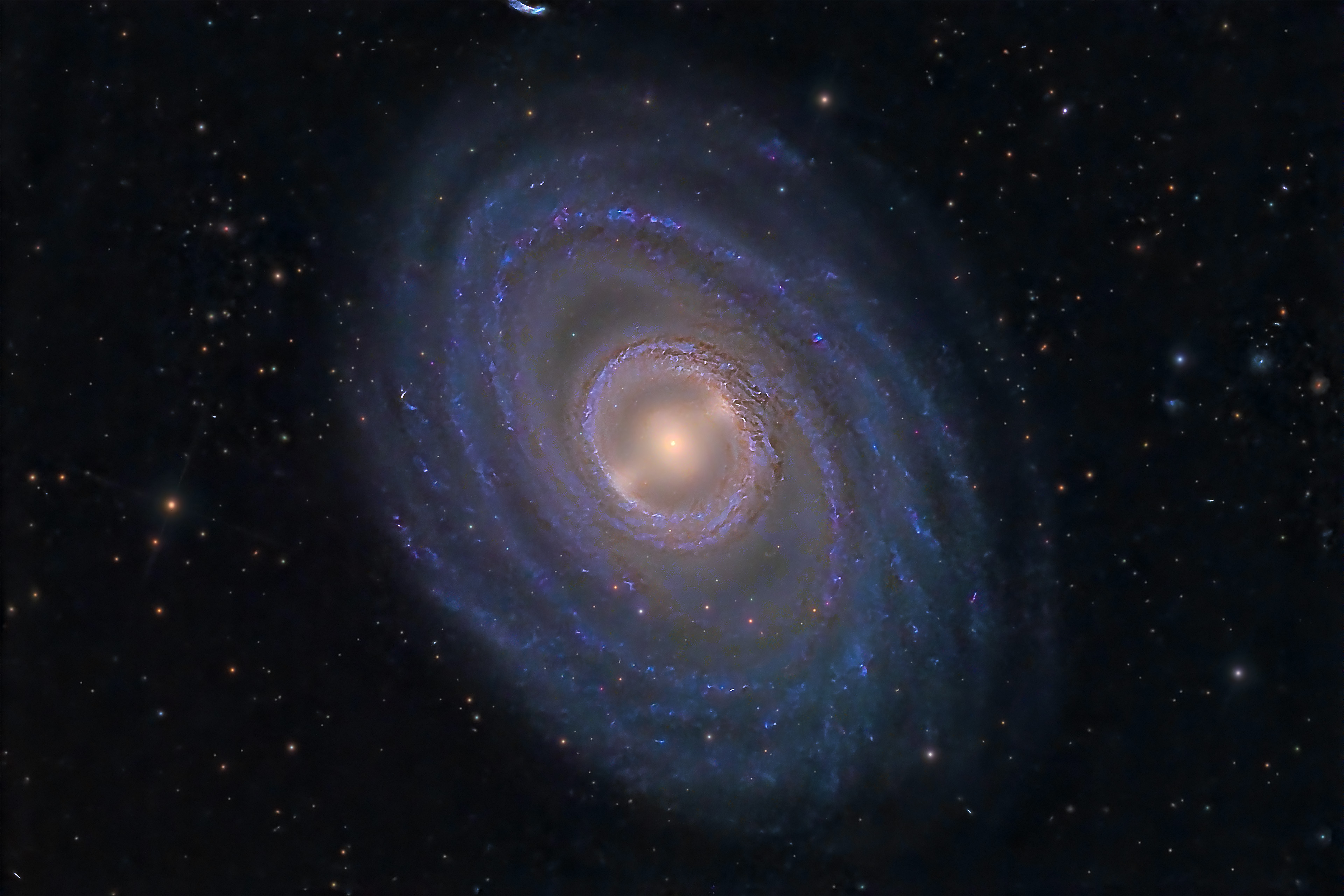
In the image above, hover a mouse or cursor over the image to
reveal annotations of NGC 1398 highlighting the bright central
bar, the nearly circular inner ring, and the smooth outer spiral
structure. Numerous faint background galaxies are scattered
throughout the field, many far beyond NGC 1398 itself. These
distant systems provide a striking sense of depth when imaging
this region of the sky.
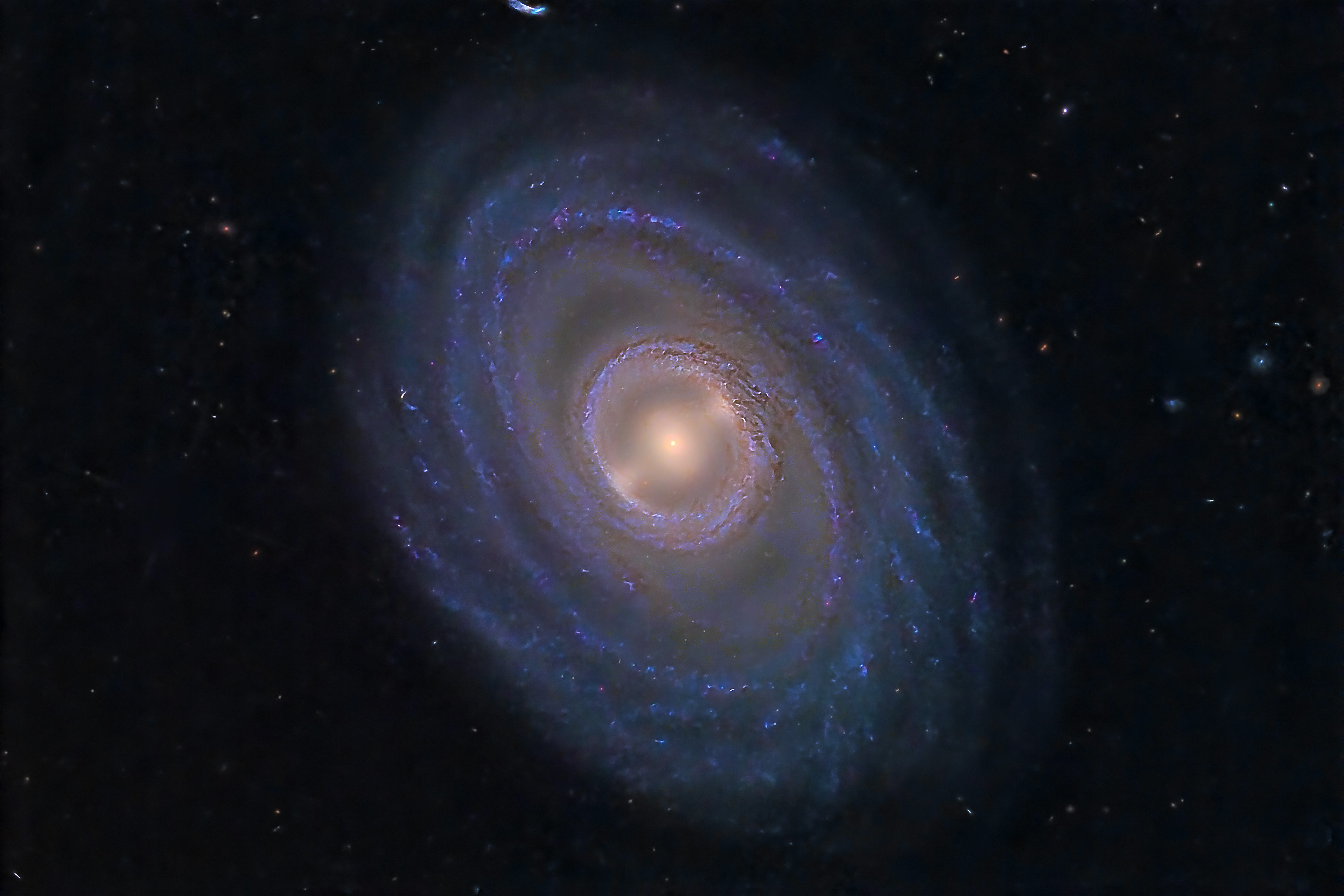
Below Images: The image
below is the same image as above but processed to remove
foreground stars from our own galaxy, providing a clearer view
of the structure of NGC 1398 itself. Hovering over the image
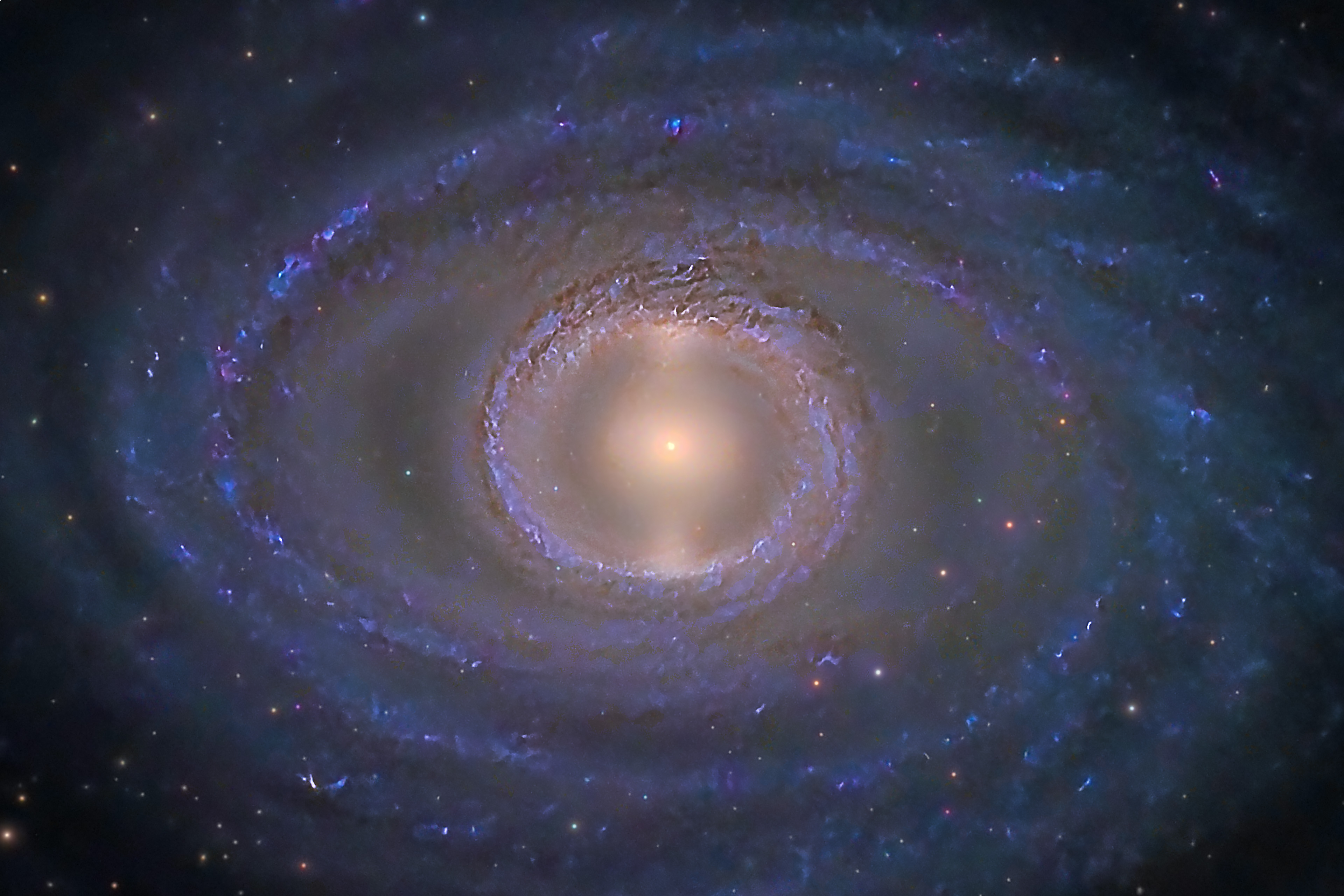
restores the stars. Additional comparison images demonstrate
improvements in processing techniques between earlier and more
recent reductions of the same dataset.
Object
Statistics: Constellation: Fornax, Right Ascension: 03
h
38
m 52
s, Declination: −26° 20′ 16″,
Apparent Magnitude: 10.5, Size: 8′.3 × 6′.8 (~135,000
light-years diameter), Distance: ~65 million light-years from
Earth.