Details: NGC 2217 was discovered
on February 23, 1835 by the English astronomer
John
Herschel during his survey of the southern skies. It is
cataloged in the
New General Catalogue, a cornerstone reference for deep-sky
astronomy. The galaxy spans approximately 4.3 by 3.4
arcminutes
and shines at an apparent
magnitude of about 10.5, placing it within reach of moderate
telescopes under dark conditions. Located roughly 65 million
light-years
from Earth, it spans on the order of 80,000–100,000 light-years,
making it somewhat smaller than the
Milky Way.
A Ringed Barred Galaxy: NGC 2217 is classified as
an (R)SB0/a galaxy — a transitional system between a
lenticular galaxy and a spiral, featuring both a prominent
bar and a well-defined outer ring. One of its most intriguing
features is this ring-like structure, which can give the
impression of a
ring galaxy.
However, unlike true ring galaxies formed by direct collisions,
the ring in NGC 2217 is believed to be a resonance ring — a
structure formed by the internal dynamics of the galaxy. These
rings arise at specific radii where stars and gas accumulate due
to orbital resonances within the galaxy’s rotating
gravitational field. In particular, the outer ring is likely
associated with the
outer
Lindblad resonance, where orbital frequencies align in a way
that traps material into a ring-like configuration.
Why the Central Bar Exists: The prominent bar in NGC 2217 is
not a static feature but a dynamic structure arising from
instabilities within the galactic disk. Over time, small
asymmetries in the distribution of mass can grow under the
influence of
gravity, leading to the formation of a bar through a process
known as
disk
instability. Once formed, the bar acts as a powerful
mechanism for redistributing angular momentum, channeling gas
inward toward the center while pushing stars outward. This
process, often referred to as
secular evolution, gradually reshapes the galaxy over
billions of years. The bar also plays a key role in organizing
the surrounding disk into rings and spiral-like features by
driving resonances at specific radii.
The Galactic Nucleus: The nucleus of NGC 2217 is bright and compact,
dominated by older, redder stars typical of evolved stellar
populations. Like most galaxies of its size, it likely hosts a
central
supermassive black hole, though it is not known to be
strongly active. Observations suggest relatively low levels of
star
formation in the central region, indicating that much of the
available gas has either been consumed or stabilized. The inward
transport of gas driven by the bar may have fueled past
activity, but the current state appears comparatively quiescent.
In some wavelengths, subtle structures such as inner rings or
lenses can be detected, further evidence of the galaxy’s
long-term dynamical evolution.
Galactic Structure and Dynamics: The overall structure of NGC 2217 reflects a
system in a mature and stable phase of evolution. The disk is
smooth and relatively featureless compared to more actively
star-forming spirals, consistent with its classification as a
transitional system. The outer ring is composed primarily of
older stars, giving it a more subdued appearance compared to the
bright, blue arms seen in galaxies with active
star
formation. The galaxy’s motion is governed by its rotating
gravitational field, with stars following nearly circular
orbits except where influenced by the bar and resonances. These
dynamics create a finely tuned system in which structure emerges
not from chaos, but from the steady interplay of forces over
cosmic time.
A Galaxy of Quiet Precision: NGC
2217 is a powerful reminder that not all galaxies are shaped by
dramatic collisions or violent interactions. Instead, it
exemplifies how internal processes — driven by
gravity,
resonance, and the redistribution of angular momentum — can
produce structures of remarkable symmetry and clarity. Its ring
is not the aftermath of destruction, but the natural outcome of
orbital mechanics operating on a galactic scale. In this sense,
NGC 2217 is less a story of chaos and more one of quiet
precision, where the laws of physics sculpt beauty over billions
of years.
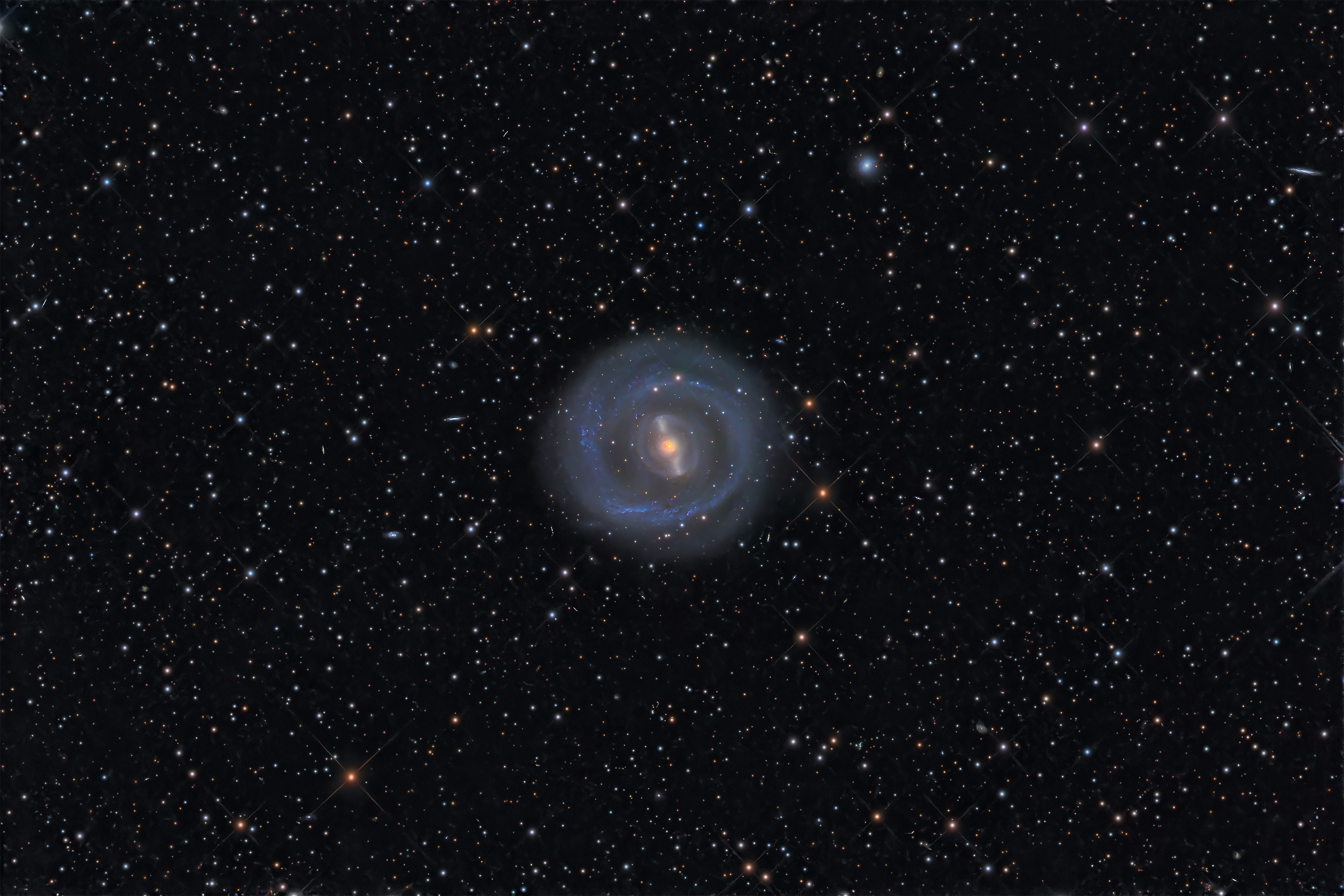
Annotations. In the image above, hover
a mouse or cursor over the image to reveal annotations
highlighting the bright central bar, the smooth inner region,
and the nearly complete outer ring. The ring may appear slightly
oval due to the galaxy’s inclination. Faint background galaxies
can often be seen scattered throughout the field, adding depth
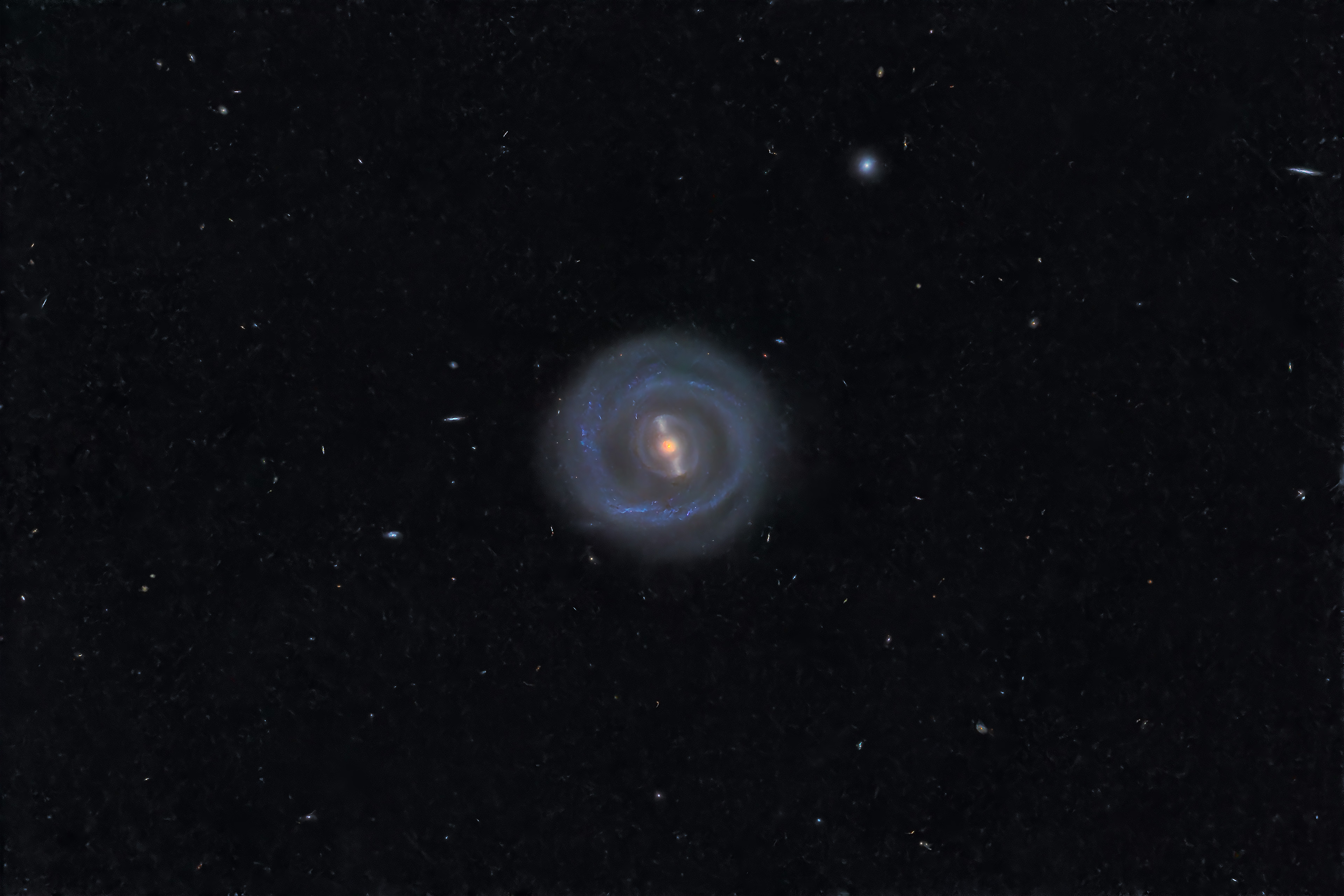
beyond NGC 2217 itself. The image
below shows the same dataset processed to reduce foreground
stars from our own galaxy, revealing the structure of NGC 2217
with greater clarity. Hovering over the image restores the
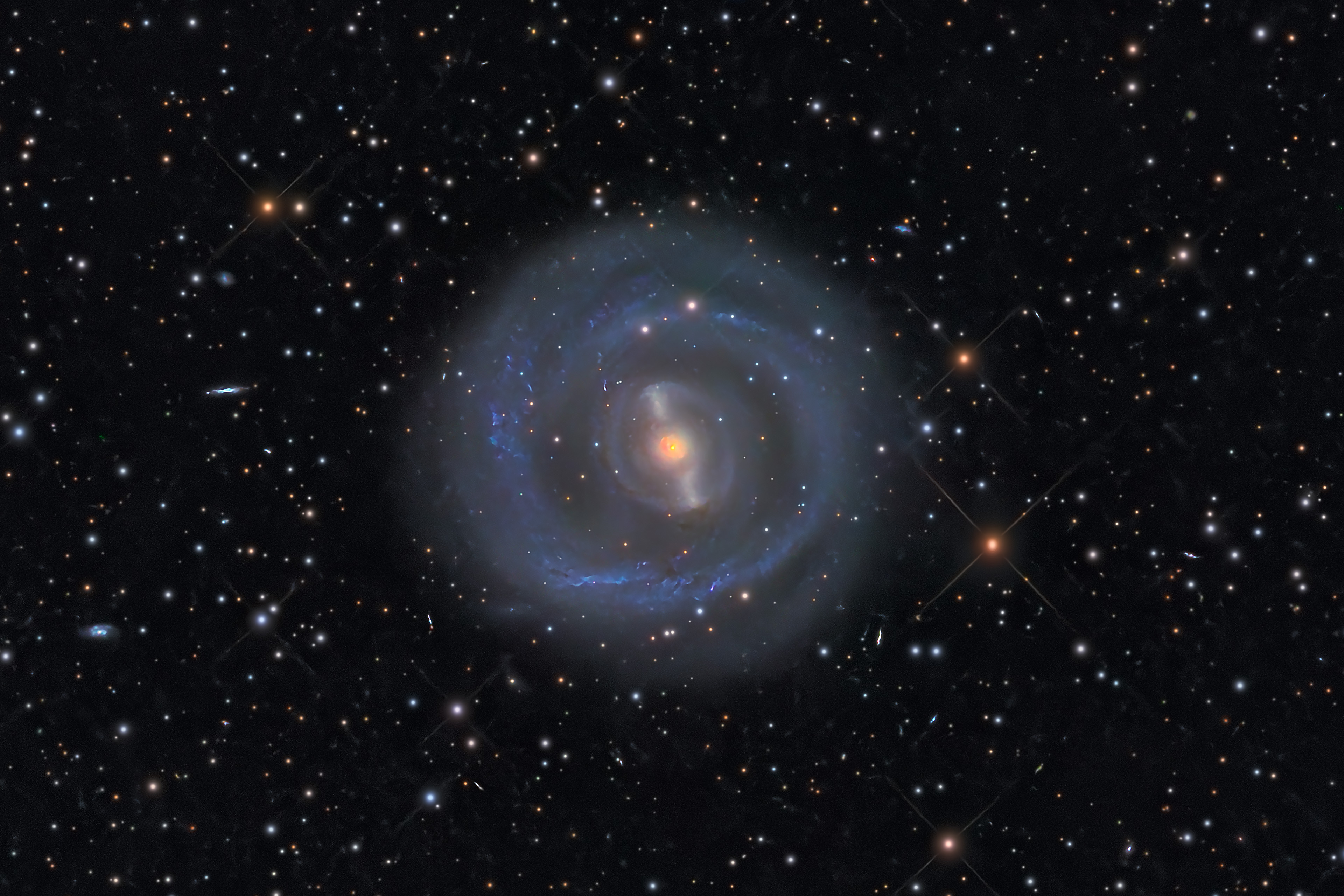
stars. The image below that shows NGC 2217 zoomed in with stars;
hover the mouse to make the stars disappear.
Object Statistics:
Constellation: Canis Major, Right Ascension: 06
h 21
m
35
s, Declination: −27° 13′ 37″, Apparent Magnitude:
10.5, Size: 4′.3 × 3′.4 (~90,000 light-years diameter),
Distance: ~65 million light-years from Earth.