Details:
NGC 2782 was discovered by the German-British astronomer
William
Herschel on March 7, 1788. The galaxy spans roughly 3 by 2
arcminutes
as seen from Earth and has an
apparent magnitude of about 11.7, making it a moderate
telescopic target but far too faint for naked-eye visibility.
NGC 2782 lies approximately 110–130 million
light-years
away, meaning the light we observe today left the galaxy when
dinosaurs still roamed Earth. The galaxy itself is roughly
50,000–60,000 light-years across, comparable to many
medium-sized spirals.
A Post-Merger Starburst Galaxy:
NGC 2782 is classified as a peculiar spiral undergoing
intense
starburst activity. A starburst galaxy experiences an
unusually high rate of
star
formation, often triggered by gravitational interactions or
mergers with smaller companion galaxies. In NGC 2782, evidence
strongly suggests it merged with a gas-rich companion roughly a
few hundred million years ago.
This interaction funneled
large amounts of gas toward the center, igniting a powerful
burst of new star formation that makes the core unusually bright
in ultraviolet and infrared wavelengths. Observations from
NASA space telescopes have
highlighted this central starburst region as one of the defining
features of the galaxy.
A Seyfert I Active Nucleus:
NGC 2782 is also classified as a
Seyfert
galaxy, specifically a
Seyfert Type I. Seyfert galaxies are a class of
active galactic nucleus (AGN) galaxies whose cores are
powered by matter accreting onto a central
supermassive black hole. In Type I Seyferts, astronomers can
directly observe both the narrow and broad emission lines from
fast-moving gas very close to the black hole, indicating an
unobscured view of the central engine. This makes NGC 2782
particularly interesting because it hosts both vigorous
starburst activity and an actively feeding nucleus.
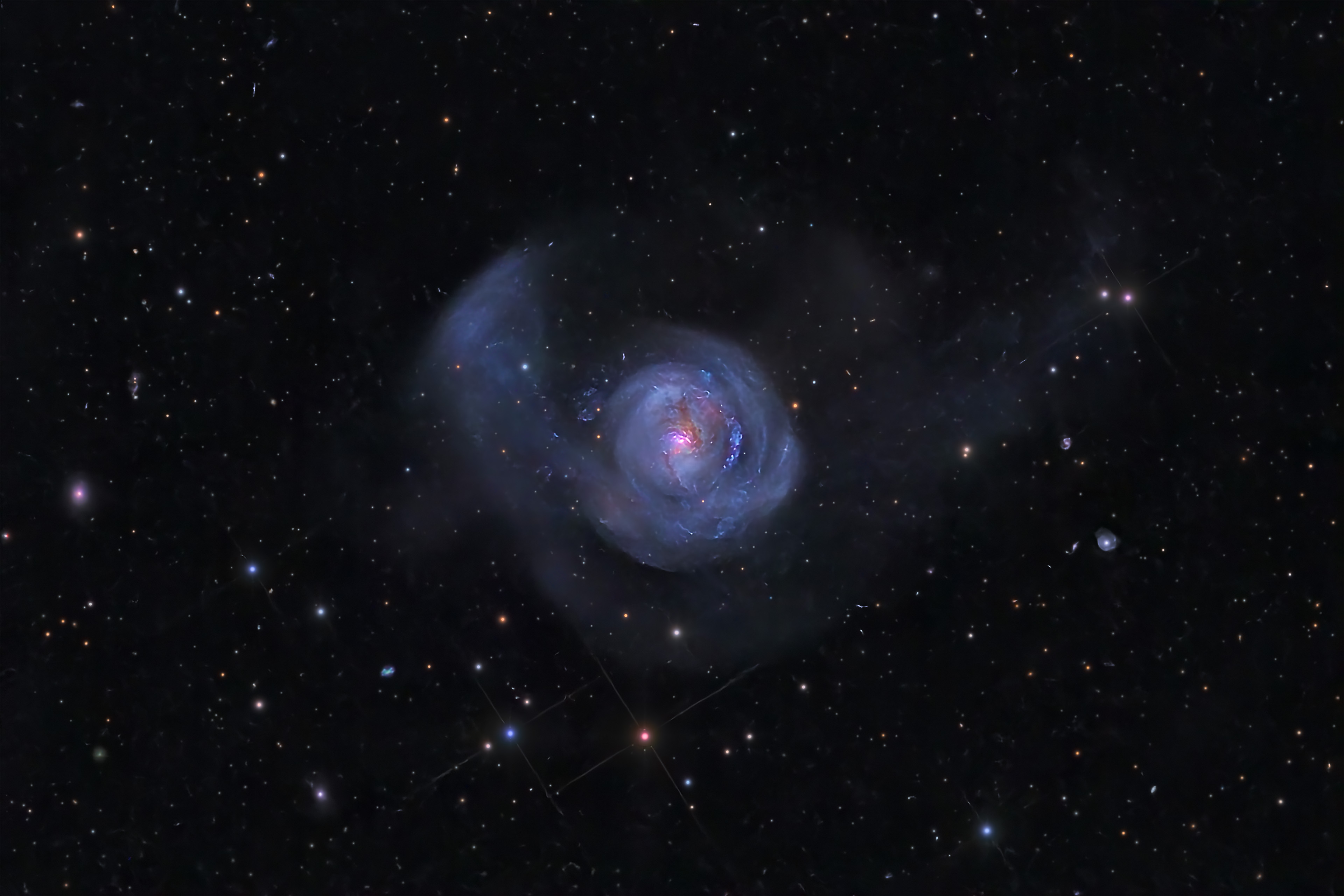
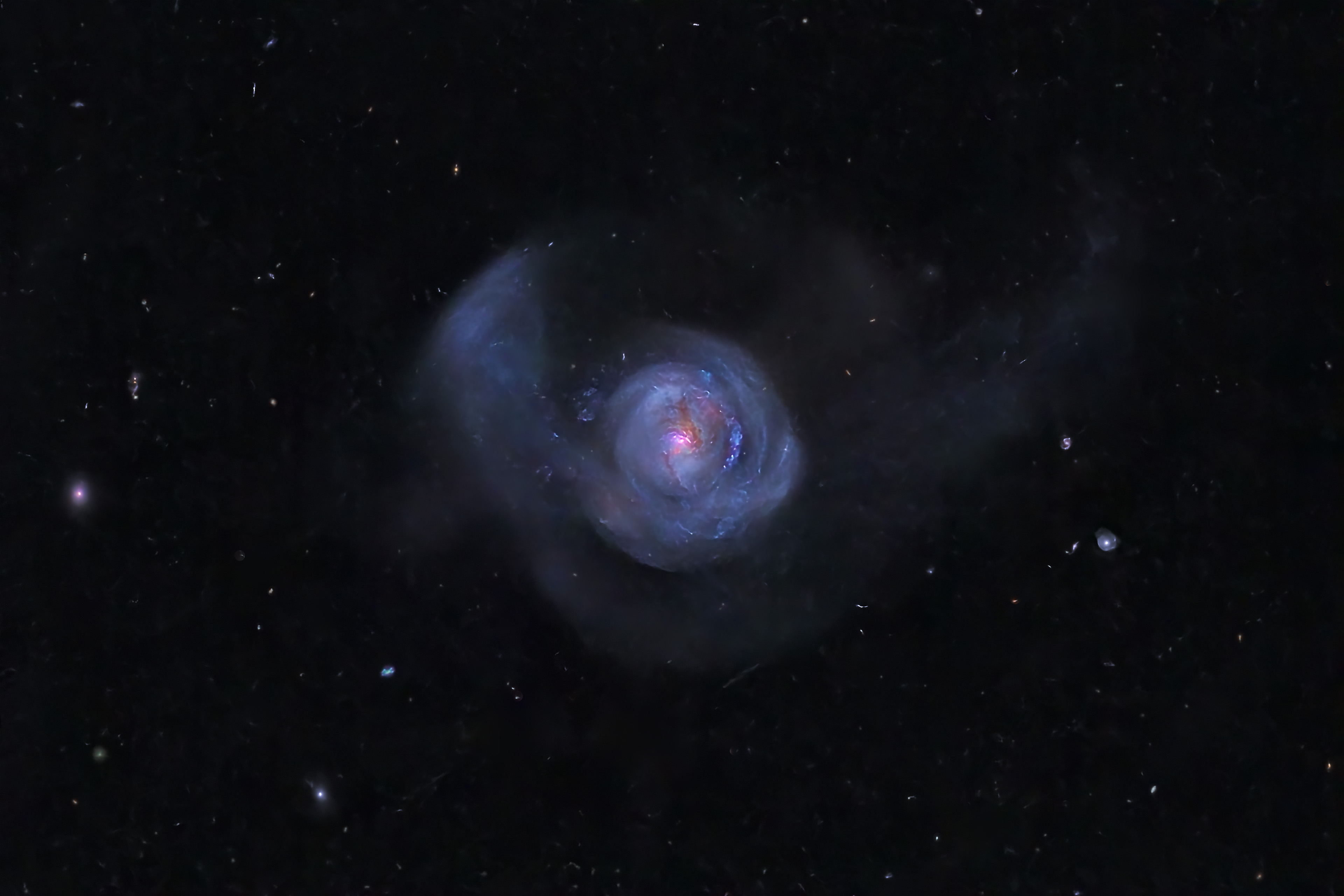
Tidal Tails and Distortions: One of the most striking
features of NGC 2782 is its asymmetric pair of tidal tails —
long streams of stars and gas pulled outward by gravitational
forces during the merger. Tidal tails are common signatures of
galaxy interactions and can stretch tens of thousands of
light-years into intergalactic space.
NGC 2782 is
unusual because its two main tidal structures are very different
in appearance:
- One tail is bright, broad, and rich in gas and star
formation.
- The opposite tail is faint and more stellar-dominated.
This asymmetry provides astronomers with clues about the mass
ratio and geometry of the original collision. The distorted
inner structure and rippled outer halo further confirm that the
galaxy has not yet fully relaxed into equilibrium.
Gas, Dust, and Future Evolution: Unlike many older
ellipticals, NGC 2782 still contains significant interstellar
gas and dust. This fuel supports ongoing star formation,
particularly in the central regions and parts of the tidal
debris. Over the next few billion years, the galaxy will likely
exhaust much of this gas and gradually evolve toward a smoother,
more elliptical-like appearance as the merger remnant settles.
Why Astronomers Study It: NGC 2782 is an
important laboratory for understanding how galaxy mergers
trigger starbursts and reshape galactic structure. It helps
researchers study:
- The physics of merger-driven starbursts
- The formation and evolution of tidal tails
- Gas inflow toward galactic nuclei
- The connection between starbursts and active galactic
nuclei
Because the merger is relatively recent on cosmic timescales,
NGC 2782 provides a valuable “snapshot” of galaxies in
mid-transformation.
Object Statistics:
Constellation: Lynx, Right Ascension: ~09
h 14
m,
Declination: ~+40° 07′, Apparent Magnitude: ~11.7, Size: ~3′ ×
2′ (~50,000–60,000 light-years), Distance: ~110–130 million
light-years from Earth.