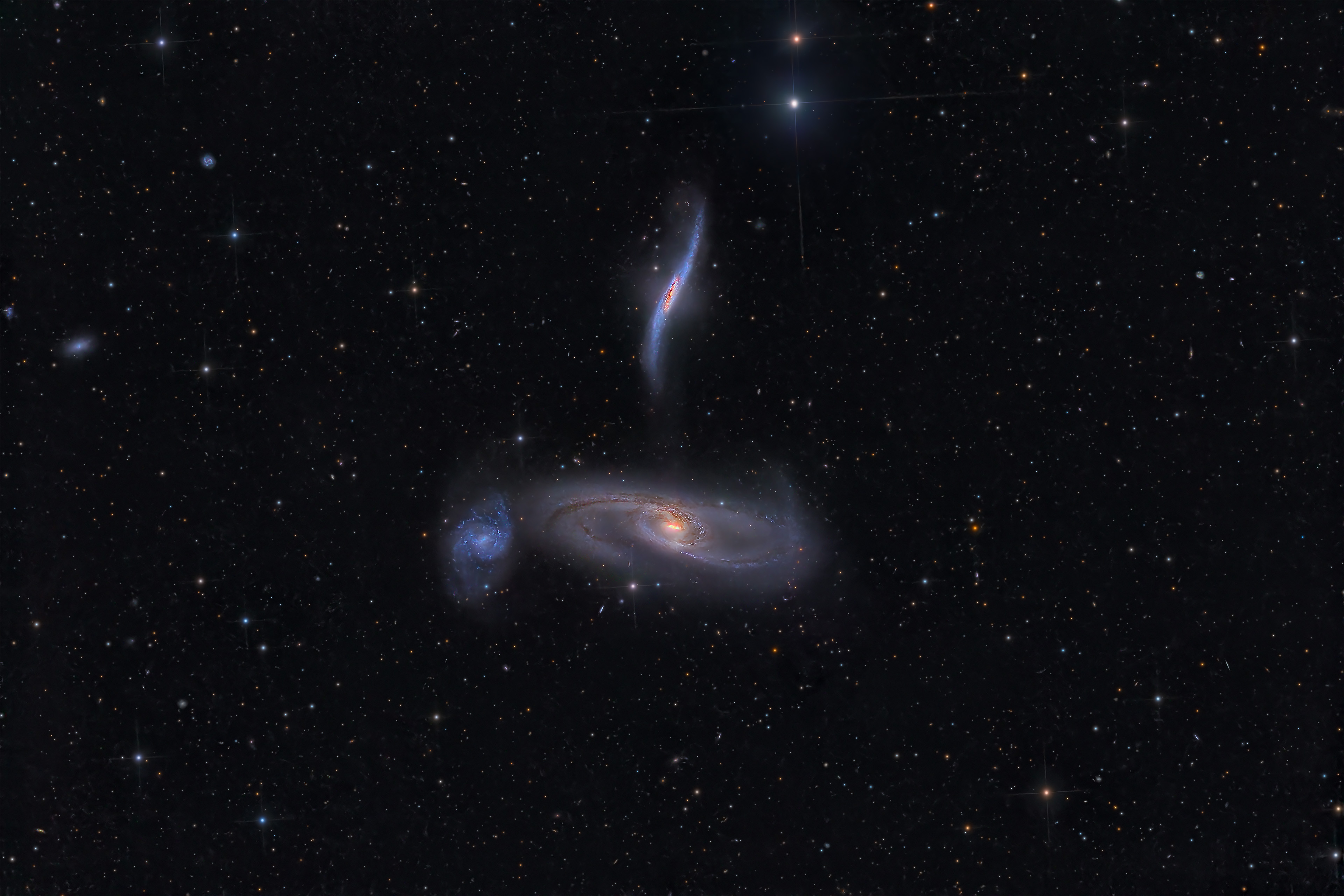
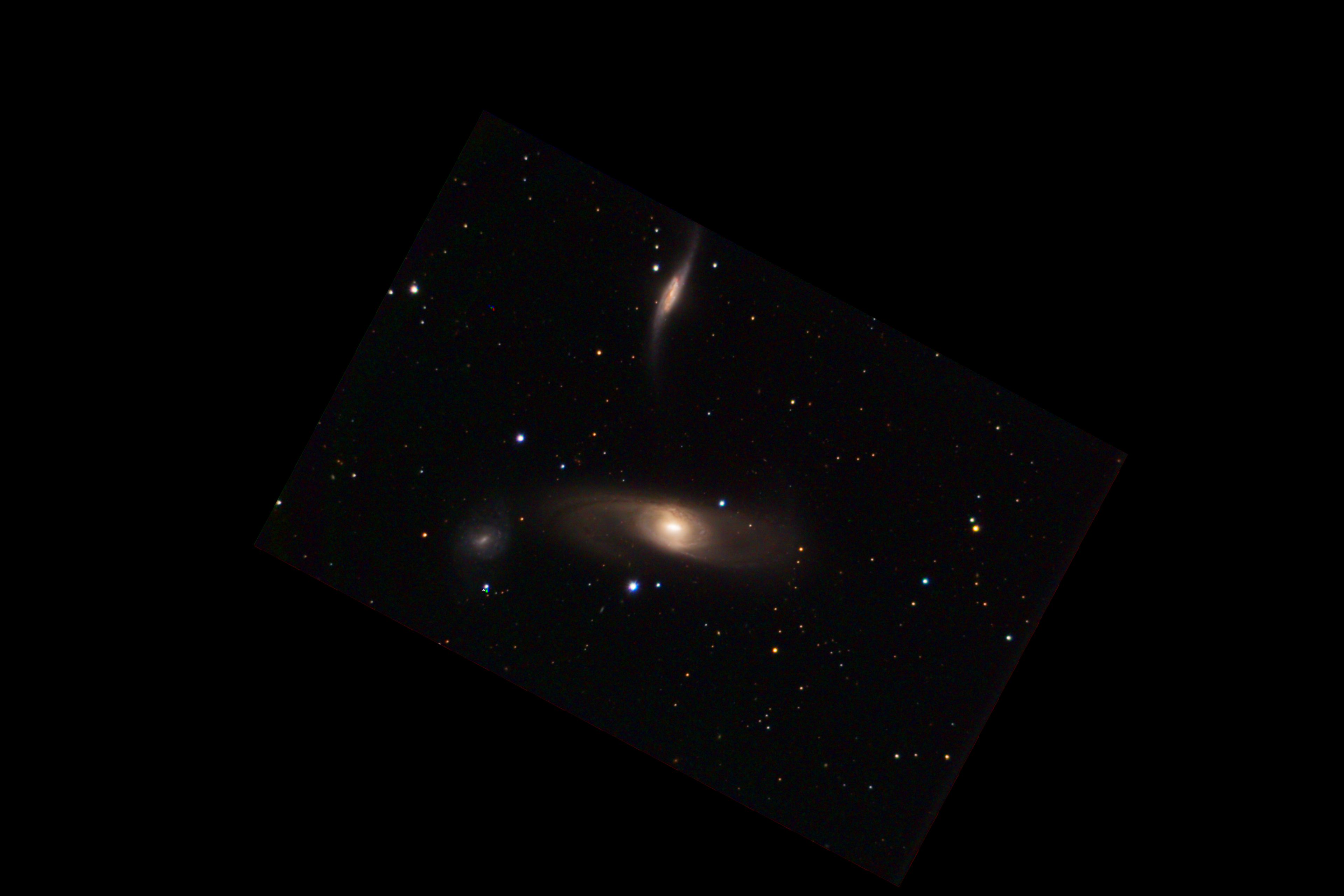
Overview: NGC 5566 is a striking
barred spiral galaxy residing in the constellation
Virgo, a region of the sky rich with galaxies and
large-scale structure. At first glance, NGC 5566 appears as a
luminous, elongated island of stars with a brilliant central
core, but closer inspection reveals a far more dynamic and
interconnected system. Its prominent central bar and sweeping
spiral arms are subtly distorted, hinting at unseen forces at
work. This galaxy is not alone, but part of a small interacting
group where the quiet elegance of spiral structure is shaped —
and at times disrupted — by the persistent pull of
gravity.
Details: Discovered on April 17, 1784 by the
German-British astronomer
William
Herschel, NGC 5566 is cataloged in the
New General Catalogue, one of astronomy’s foundational
references for deep-sky objects. The galaxy spans approximately
5.8 by 2.7
arcminutes as seen from Earth, its elongated appearance
reflecting an inclined orientation. With an apparent
magnitude of about 10.5, it is beyond naked-eye visibility
but accessible to moderate telescopes under dark skies. Located
roughly 70 million
light-years
away, it stretches over 150,000 light-years in diameter, making
it comparable in scale to the
Milky Way.
A Disturbed Barred Spiral: Classified as an
SB(r)ab galaxy, NGC 5566 contains a strong central bar and a
partially developed inner ring. In
barred spiral galaxies, the bar acts as a gravitational
engine, redistributing gas and stars and helping to shape the
surrounding disk. In this case, however, the galaxy’s structure
is not perfectly symmetrical. Its spiral arms appear slightly
stretched and uneven — evidence of
tidal forces
arising from nearby companions. These forces compress gas in
some regions while pulling it apart in others, often triggering
localized bursts of
star
formation.
The Arp 286 System: NGC 5566 is
the dominant member of the interacting trio known as
Arp 286,
part of the influential
Atlas of Peculiar Galaxies compiled by
Halton Arp
in 1966. Arp’s catalog highlighted galaxies with unusual or
disturbed morphologies, many of which are now understood to be
systems undergoing
gravitational interactions. These peculiar galaxies provided
early observational evidence that collisions and close
encounters play a central role in galactic evolution.
Within this system, NGC 5560 appears as a smaller but visibly
distorted
spiral galaxy, its uneven arms stretched by tidal
interactions. With an apparent magnitude near 12.4 and a modest
angular size of a few arcminutes, it reveals clear signs of
disruption in deep imaging. Nearby, NGC 5569 is fainter still —
around magnitude 14 — and more diffuse, yet it too shows
evidence of structural disturbance. Together, these galaxies
form a physically associated group tens of millions of
light-years away, where the slow exchange of mass and angular
momentum continues to reshape each member over cosmic time.
Galactic Bridges and Tidal Streams: In deep,
carefully processed images of interacting systems like Arp 286,
astronomers sometimes detect faint “bridges” of stars and gas
extending between galaxies. These structures, known as
tidal tails
or stellar bridges, form when
tidal forces
pull material away from galactic disks during close encounters.
Though often extremely faint, they provide compelling visual
evidence that galaxies are exchanging mass and energy. In the
case of NGC 5566 and its companions, subtle extensions and
distortions in the outer regions hint at such features,
suggesting that stars and interstellar material may be flowing
between these galaxies — a slow cosmic transfer unfolding over
hundreds of millions of years. These bridges are not only
visually striking but scientifically vital, offering direct
insight into how galaxies grow, merge, and evolve through
interaction.
Galactic Structure and Dynamics: The
core of NGC 5566 is bright and compact, dominated by older stars
concentrated in a central bulge. Like most large galaxies, it
likely hosts a
supermassive black hole at its center. The surrounding disk
contains a mixture of stellar populations, with younger, hotter
stars tracing the spiral arms. Observations across multiple
wavelengths reveal complex dust structures and regions of active
star formation, particularly where tidal forces have compressed
interstellar gas. The galaxy’s internal motion is governed by
its overall
gravitational field, yet this equilibrium is continually
perturbed by its companions, producing the subtle asymmetries
visible today.
Foreground Stars and Line-of-Sight
Contrast: Adding a striking visual foreground to this
distant interaction are two stars from our own galaxy: SAO
120403 and SAO 120402. Shining at apparent magnitudes of
approximately 8.2 and 9.7, these stars belong to the
Milky Way
and are cataloged in the
SAO Star Catalog. Though they appear embedded in the same
field as the galaxies, they are vastly closer — separated from
NGC 5566 and its companions by tens of millions of light-years.
In astrophotography, they often produce bright halos and
diffraction spikes, providing a sharp contrast to the soft,
diffuse glow of the distant galaxies.
A Dynamic and
Layered Cosmic Scene: What makes this region especially
compelling is its profound sense of depth and motion. In a
single frame, one can observe nearby stars within our own
galaxy, an interacting group of spiral galaxies bound by
gravity, and countless faint background systems stretching far
beyond. The inclusion of Arp 286 connects this scene to a
broader scientific narrative — one in which galaxies are not
static islands, but evolving systems shaped by both internal
dynamics and external encounters. Here, the interplay of
gravitational fields, the birth of stars, and the slow
choreography of galactic interaction come together in a single,
breathtaking tableau.
Annotations. In the image
above, hover a mouse or cursor over the image to reveal
annotations highlighting the bright central bar of NGC 5566, its
elongated bulge, and its subtly distorted spiral arms. Companion
galaxies NGC 5560 and NGC 5569 can be identified nearby, along
with the bright foreground stars SAO 120403 and SAO 120402.
Numerous faint background galaxies are scattered throughout the
field, adding depth and context to the scene.
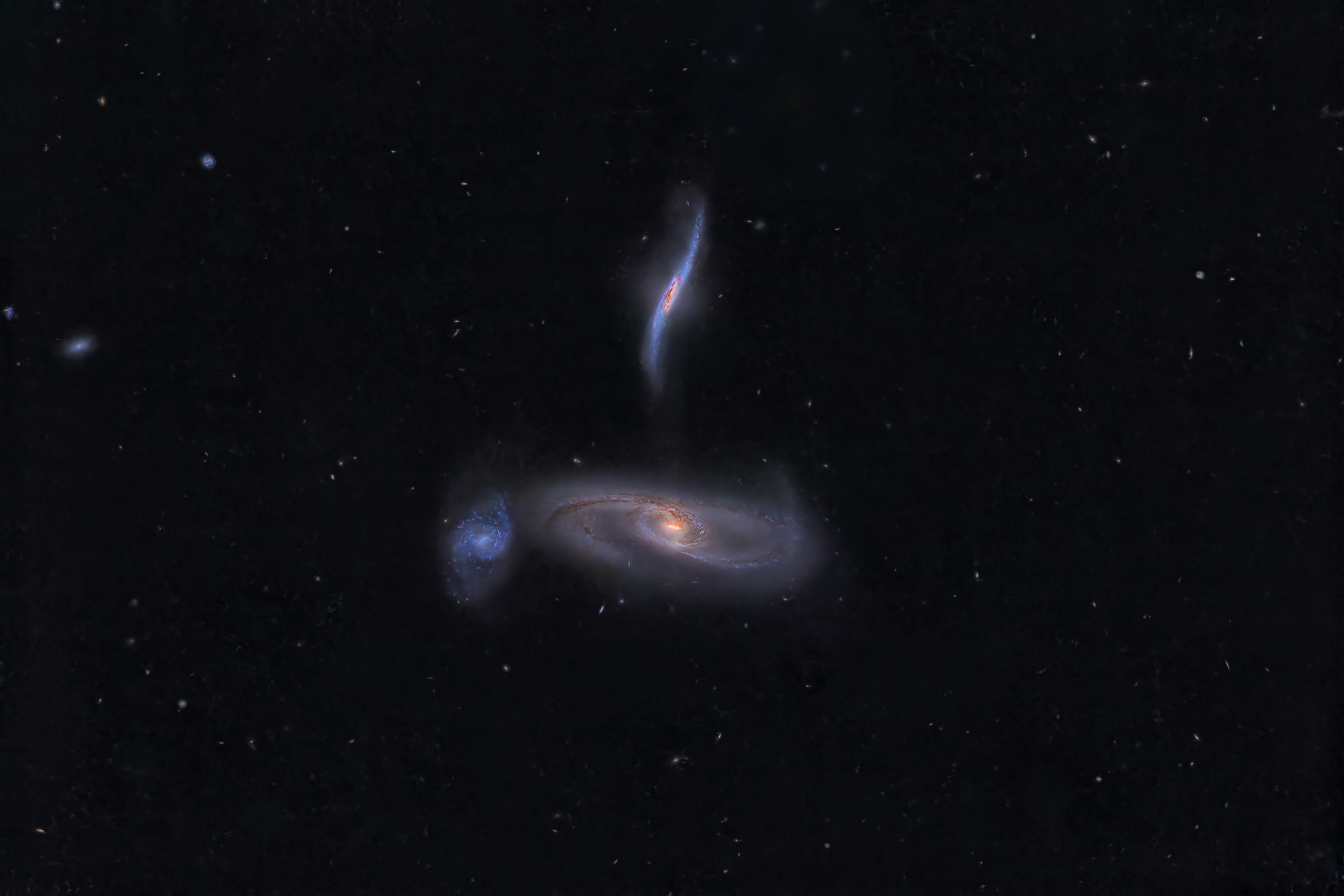
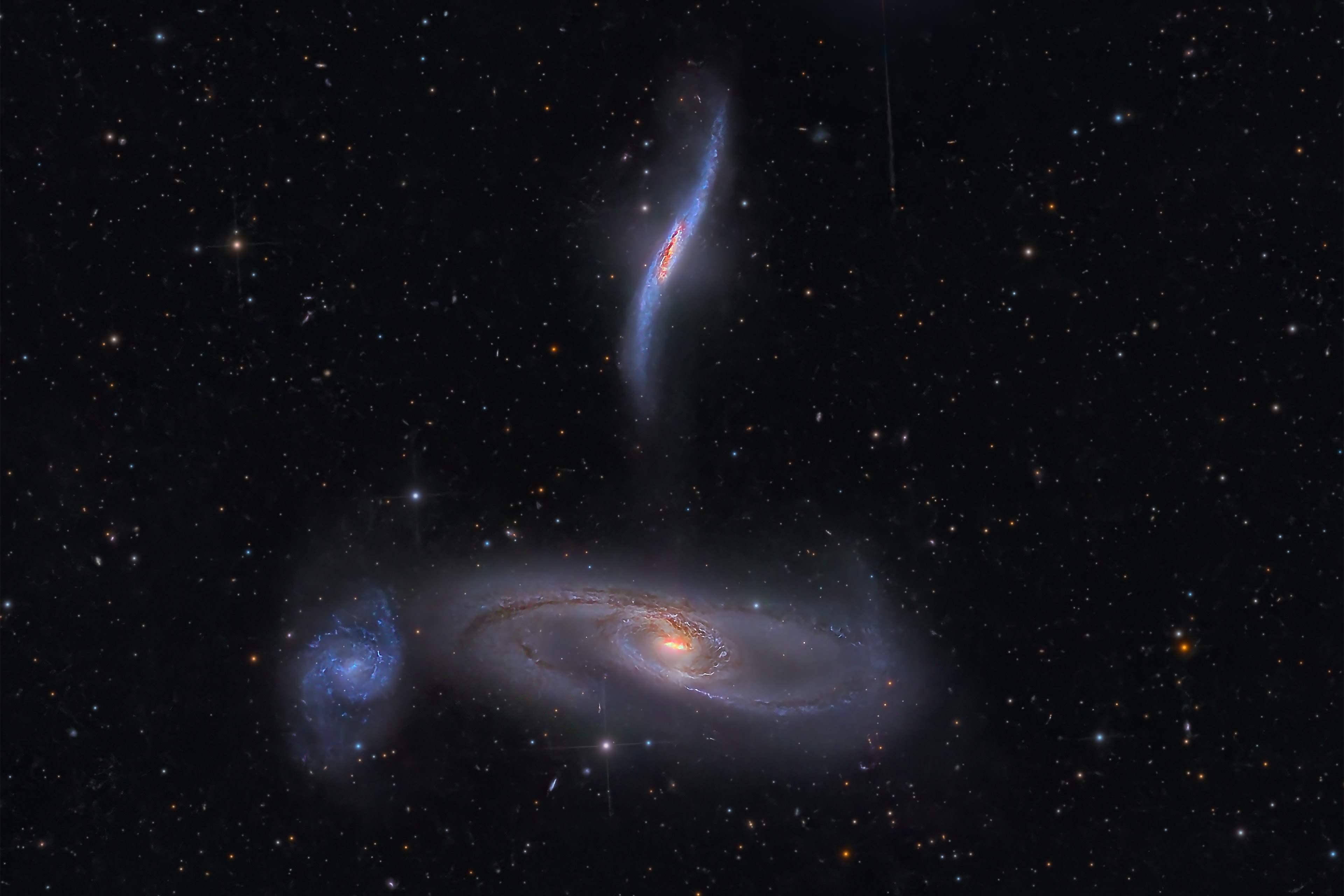
Below
Images: The image below presents the same field with
foreground stars reduced or removed, allowing a clearer view of
the interacting galaxies and their delicate structures. Hovering
over the image restores the stars. Additional comparison images
illustrate how different processing techniques reveal faint
tidal features and structural details otherwise hidden in raw
data.
Object Statistics: Constellation: Virgo,
Right Ascension: 14
h 20
m 19
s,
Declination: +03° 56′ 01″, Apparent Magnitude: 10.5, Size: 5′.8
× 2′.7 (~150,000 light-years diameter), Distance: ~70 million
light-years from Earth. .