Details: The three principal galaxies of the NGC 7771
Group were discovered on the same night,
September 18, 1784,
by the German-British astronomer
William
Herschel. They are cataloged today as
NGC 7769,
NGC 7770, and
NGC 7771. The group lies approximately
200 million light-years from Earth, corresponding to a
distance of roughly 60 megaparsecs. NGC 7771 is the largest and
most conspicuous member, with an apparent magnitude near 12 and
an estimated physical diameter of roughly 75,000–140,000
light-years depending upon the distance and size definition
used. NGC 7769 is a similarly bright but more face-on spiral,
while the much smaller NGC 7770 lies immediately beside NGC
7771. The system is also known as
Holmberg 820 and is
included in galaxy-group catalogs as
LGG 483 and
WBL
726.
A Family within the Virgo Supercluster: The NGC 7771 Group
occupies a much larger place in the cosmic hierarchy than its
compact appearance might suggest. Galaxy groups such as this one
are themselves components of larger concentrations of galaxies,
and the NGC 7771 Group has been cataloged as a member of the
Virgo Supercluster. The Virgo Supercluster is an enormous
concentration of galaxies extending across hundreds of millions
of light-years and containing numerous galaxy groups and
clusters. In this broader sense, NGC 7771 is not an isolated
island of galaxies but part of the vast large-scale structure
that organizes matter across our nearby region of the universe.
The distinction is important: the NGC 7771 Group is a small
gravitationally associated system, while the Virgo Supercluster
represents a vastly larger network of galaxy groups and
clusters.
The Three Principal Galaxies: At the heart of the group are
three galaxies engaged in an extraordinary gravitational
encounter.
NGC 7771 is the dominant member, a barred
spiral galaxy viewed at a steep inclination that makes its disk
appear dramatically elongated. Its central bar and surrounding
disk have been strongly disturbed by interactions with its
companions.
NGC 7769, in contrast, is oriented much more
nearly face-on and presents a rounder, brighter spiral
appearance. The third major member,
NGC 7770, is
considerably smaller and more compact. Deep images reveal that
this apparently tiny galaxy is far more interesting than its
size suggests: its shape and internal structure have been
distorted by its close encounter with massive NGC 7771. The
three galaxies therefore provide three different views of the
same gravitational drama—a large edge-on spiral, a face-on
spiral, and a compact companion caught in the process of being
transformed.
The Galactic Dance: The most spectacular aspect of the NGC
7771 Group is not simply the proximity of its members, but the
evidence that they have already passed close to one another.
Gravity does not require galaxies to collide head-on to produce
enormous changes. When two galaxies pass within tens of
thousands of light-years of one another, the gravitational
forces acting across their immense disks can pull stars and gas
outward into enormous tidal structures. In NGC 7771, these
forces have distorted the outer disk and produced faint
extensions and streams reaching far beyond the bright visible
galaxy. The interaction with NGC 7769 appears to have been an
earlier close passage, while NGC 7770 has subsequently undergone
a much more intimate interaction with NGC 7771. Detailed studies
of the galaxies' velocity fields show distortions consistent
with these gravitational encounters.
The Tidal Tails: Among the most difficult structures to capture in
ordinary photographs are the
tidal tails and stellar streams
surrounding the galaxies. These immense structures consist of
stars, gas, and dust that have been pulled away from their
parent galaxies by gravitational tides. Unlike the bright
central disks, the tails contain relatively few stars spread
over enormous areas, making their surface brightness
extraordinarily low. This is why they become visible only in
long-exposure images processed to reveal extremely faint
structures. What may look like a subtle haze surrounding the
galaxies is actually evidence of billions of stars and enormous
quantities of gas displaced from their original orbits. The
tidal structures provide astronomers with a kind of
archaeological record, preserving evidence of previous
encounters long after the galaxies themselves have begun to
settle back into more familiar forms.
NGC 7771 — A Galaxy Under Assault: NGC 7771 is particularly fascinating
because its structure has been dramatically altered by its
interactions with its companions. It is classified as a barred
spiral, and its highly inclined disk reveals a bright central
region surrounded by a complex system of dust and star-forming
material. The galaxy's rotation is also strongly disturbed.
Instead of rotating as an isolated spiral galaxy would,
different portions of its disk exhibit motions that reflect the
gravitational forces exerted by nearby companions. Observations
of its neutral hydrogen reveal extended structures far beyond
the optical disk, providing additional evidence that the
interaction has stripped material from the galaxy and
redistributed it throughout the surrounding space.
A Galactic Starburst: The gravitational encounters have done more than
distort the galaxies—they have also stimulated
star
formation. NGC 7771 is classified as a
luminous infrared
galaxy, or LIRG, indicating that a substantial amount of its
energy is emitted at infrared wavelengths by dust heated by
intense stellar activity. Much of the galaxy's most vigorous
star formation is therefore hidden from ordinary visible-light
observations. At the center of NGC 7771 lies a particularly
powerful
circumnuclear starburst, where enormous numbers
of young stars are forming in a relatively compact region around
the nucleus. Astronomers believe that the gravitational
interactions with the surrounding galaxies helped drive gas
inward toward the center, providing the raw material needed to
ignite this intense episode of star formation.
The Luminous Infrared Galaxy: The classification of NGC 7771 as a LIRG
adds another dimension to the story. In visible light, much of
the galaxy's activity is obscured by thick clouds of
interstellar dust. But infrared radiation passes more readily
through these clouds, allowing astronomers to see the otherwise
hidden starburst. This makes NGC 7771 an excellent example of
how a galaxy can appear relatively calm in visible light while
actually undergoing an enormous transformation deep within its
dusty interior. The energy being released by young massive stars
heats the surrounding dust, causing the galaxy to shine
extraordinarily brightly in infrared wavelengths.
NGC 7770 — The Small Galaxy Being Transformed: The diminutive
NGC 7770
may be the most dramatic example of interaction in the group.
Although it appears almost stellar in small telescopes,
higher-resolution observations reveal a compact galaxy with a
distorted structure and indications of a complex central region.
Its interaction with the much larger NGC 7771 has altered its
shape and internal motions. Rather than simply passing
harmlessly through the group, NGC 7770 appears to be
experiencing a genuine gravitational encounter that may
ultimately lead to its merger with NGC 7771. This is a vivid
example of the fact that galaxy mergers are not necessarily
equal partnerships: a massive galaxy can gradually absorb a much
smaller companion, stripping away its stars and gas in the
process.
NGC 7769 — The Face-On Spiral: The third major member,
NGC
7769, provides a striking contrast to NGC 7771. Its disk is
oriented much more nearly face-on toward Earth, allowing its
spiral structure to be seen from above. Although it appears less
dramatically disturbed than NGC 7771, detailed observations
reveal subtle distortions in its rotation and outer structure
that are consistent with gravitational interaction. The apparent
serenity of NGC 7769 is therefore deceptive. It too is
participating in the slow gravitational exchange taking place
throughout the group, and its future may ultimately be tied to
the fate of its companions.
NGC 7771A and the Fainter Members: Deep astrophotography reveals that
the story does not necessarily end with the three bright NGC
galaxies. A much fainter galaxy commonly designated
NGC 7771A
lies near NGC 7771 and has been identified in some studies as a
possible dynamical member of the group. Additional faint
galaxies, including
UGC 12828 and
NGC 7786, have
also been associated with the larger NGC 7771 Group in different
catalogs. Because these objects are extremely faint and their
distances are difficult to measure, the exact membership of the
group remains somewhat catalog-dependent. Deep images therefore
reveal a miniature ecosystem of galaxies extending well beyond
the three obvious members.
The Hidden Gas: The gravitational interaction becomes even more
dramatic when observed at radio wavelengths. Neutral hydrogen,
or
H I, extends well beyond the bright stellar disks of
the galaxies and traces enormous reservoirs of cold gas that can
be pulled outward during close encounters. In the NGC 7771
system, observations of the hydrogen distribution reveal
extended structures and tidal features that are much more
difficult to see in ordinary optical images. Because this cold
gas is the raw material from which future stars are made, the
interaction is not merely rearranging existing stars—it is also
redistributing the fuel for future generations of stars.
Integrated Flux Nebulae: Adding another layer of complexity to deep
images of this group is the presence of faint
Integrated Flux
Nebulae, or
IFN, in the foreground of the field.
These extremely diffuse clouds are not part of the NGC 7771
Group at all. They are clouds of dust within our own
Milky Way
Galaxy, located only a few hundred light-years away. They
reflect the combined light of millions of distant stars and
appear as extremely faint, ghostly patches of illumination.
Because the NGC 7771 Group lies nearly 200 million light-years
behind them, the IFN forms a remarkable cosmic foreground
screen. A single deep photograph can therefore capture dust only
hundreds of light-years away and galaxies hundreds of millions
of light-years away in the same frame—a difference in distance
of roughly a million to one.
A Supernova: NGC 7771 has also hosted at least one recorded
supernova,
SN 2003hg, discovered in August 2003. The explosion
provides another glimpse into the vigorous stellar activity
taking place within this interacting system. Massive stars live
only a tiny fraction of the age of a galaxy before ending their
lives in catastrophic explosions. In a galaxy undergoing
interaction-driven star formation, these stellar deaths are part
of the same larger cycle: gravitational encounters compress gas,
compressed gas forms massive stars, and those stars eventually
return enriched material to the interstellar medium through
stellar winds and supernova explosions.
The Future of the Group: The galaxies we see today will not remain
separate forever. Repeated close encounters gradually remove
orbital energy and redistribute angular momentum, causing the
galaxies to spiral closer together. Over hundreds of millions to
billions of years, NGC 7770 is expected to become increasingly
absorbed by NGC 7771, while the larger NGC 7769 may also
eventually participate in the merger. The final result will
likely be a much larger galaxy whose appearance bears little
resemblance to the elegant trio visible today. The faint tidal
streams surrounding the present-day galaxies are therefore not
random decorations—they are the first visible evidence of the
future merger already underway.
A Preview of Our Own Future: The fate of the NGC 7771 Group offers a
fascinating glimpse into the future of our own
Milky Way.
Galaxy mergers are a normal part of cosmic evolution. The Milky
Way itself is expected to undergo a major interaction with the
Andromeda Galaxy in the distant future. Like NGC 7771, the
Milky Way and Andromeda will experience enormous gravitational
distortions as their disks interact. Yet despite the spectacular
appearance of galactic collisions, direct collisions between
individual stars are extraordinarily unlikely because the
distances between stars are so enormous. Galaxies merge; stars
mostly pass one another. What changes dramatically is the
gravitational environment, the distribution of gas and dust, and
the rate at which new stars are born.
A Cosmic Laboratory: The NGC 7771 Group provides astronomers with a
remarkably detailed laboratory for studying the physics of
interacting galaxies. It combines several important phenomena in
one compact system: tidal distortion, gas stripping, enhanced
star formation, a circumnuclear starburst, infrared emission,
disturbed rotation, extended hydrogen structures, and the
gradual transition from individual galaxies toward a future
merged system. Because the group is close enough for individual
structures to be studied while still far enough away that its
galaxies appear together in a relatively small region of sky, it
is an ideal natural laboratory for investigating how
gravitational encounters transform galaxies.
One Photograph, Millions of Years of History: Perhaps the most
remarkable aspect of the NGC 7771 Group is that a deep
astrophotograph captures far more than three galaxies. It
captures the aftermath of encounters that began hundreds of
millions of years ago and the opening stages of mergers that may
continue for hundreds of millions of years into the future. The
distorted disks record past gravitational encounters. The tidal
tails preserve streams of stars pulled from their original
homes. The glowing star-forming regions reveal the consequences
of compressed gas. The faint infrared-bright starburst tells of
activity hidden behind dust. And the eventual merger of these
galaxies represents another step in the endless process by which
the universe builds larger and more complex galaxies from
smaller ones. What looks like a quiet arrangement of faint
smudges in the constellation Pegasus is actually a spectacular
cosmic event frozen in time.
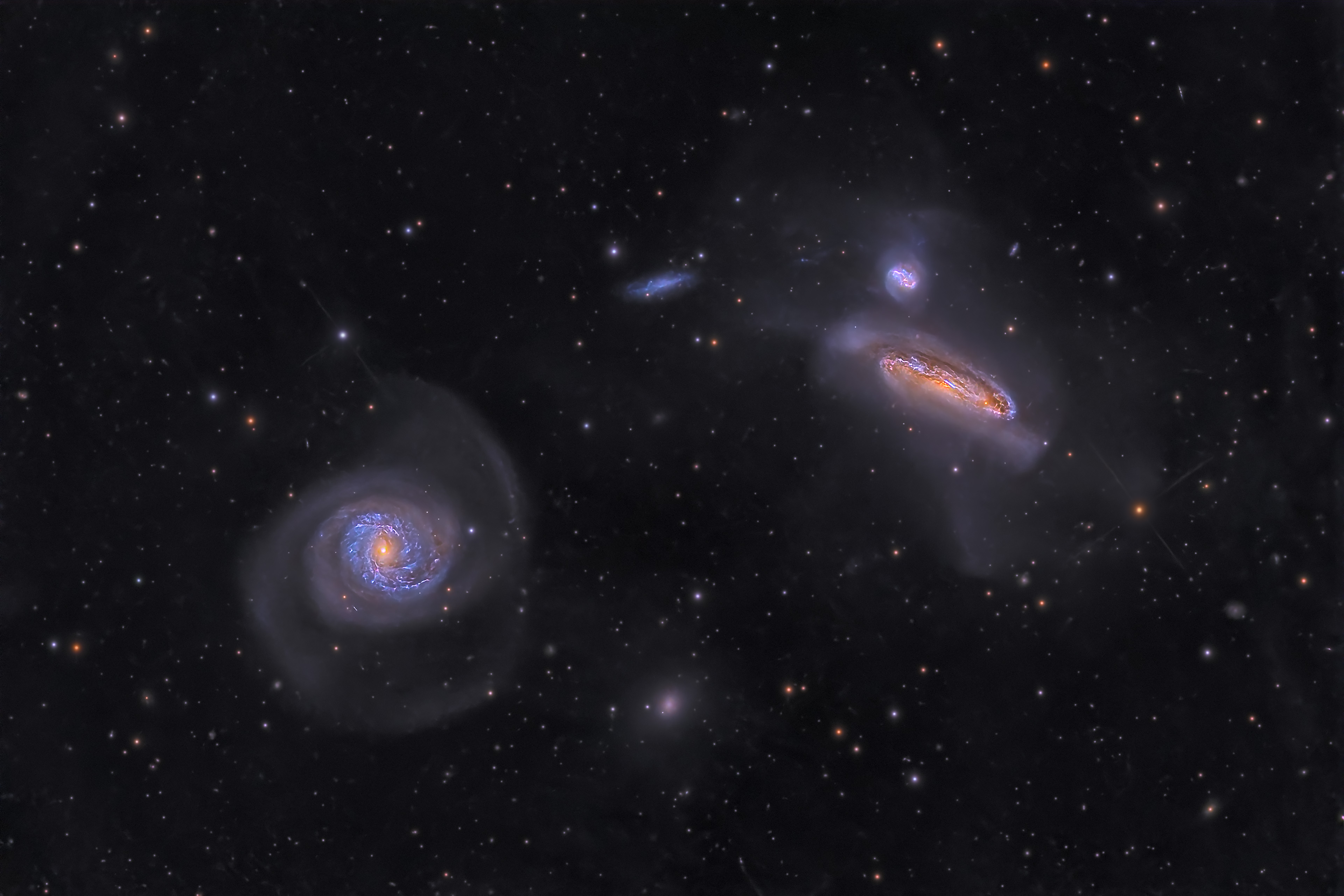
Annotations: In the annotated image above, hover your mouse or cursor over the image
to reveal annotations identifying the principal members of the
NGC 7771 Group, including the highly inclined barred spiral
NGC 7771, the face-on spiral
NGC 7769, the compact
interacting companion
NGC 7770, and the much fainter
NGC 7771A. Additional annotations highlight the faint tidal
extensions and streams surrounding the galaxies, as well as
other background galaxies visible in the deep exposure. The
annotations help distinguish structures that are physically
associated with the interacting group from the faint foreground
Integrated Flux Nebulae belonging to our own Milky Way.
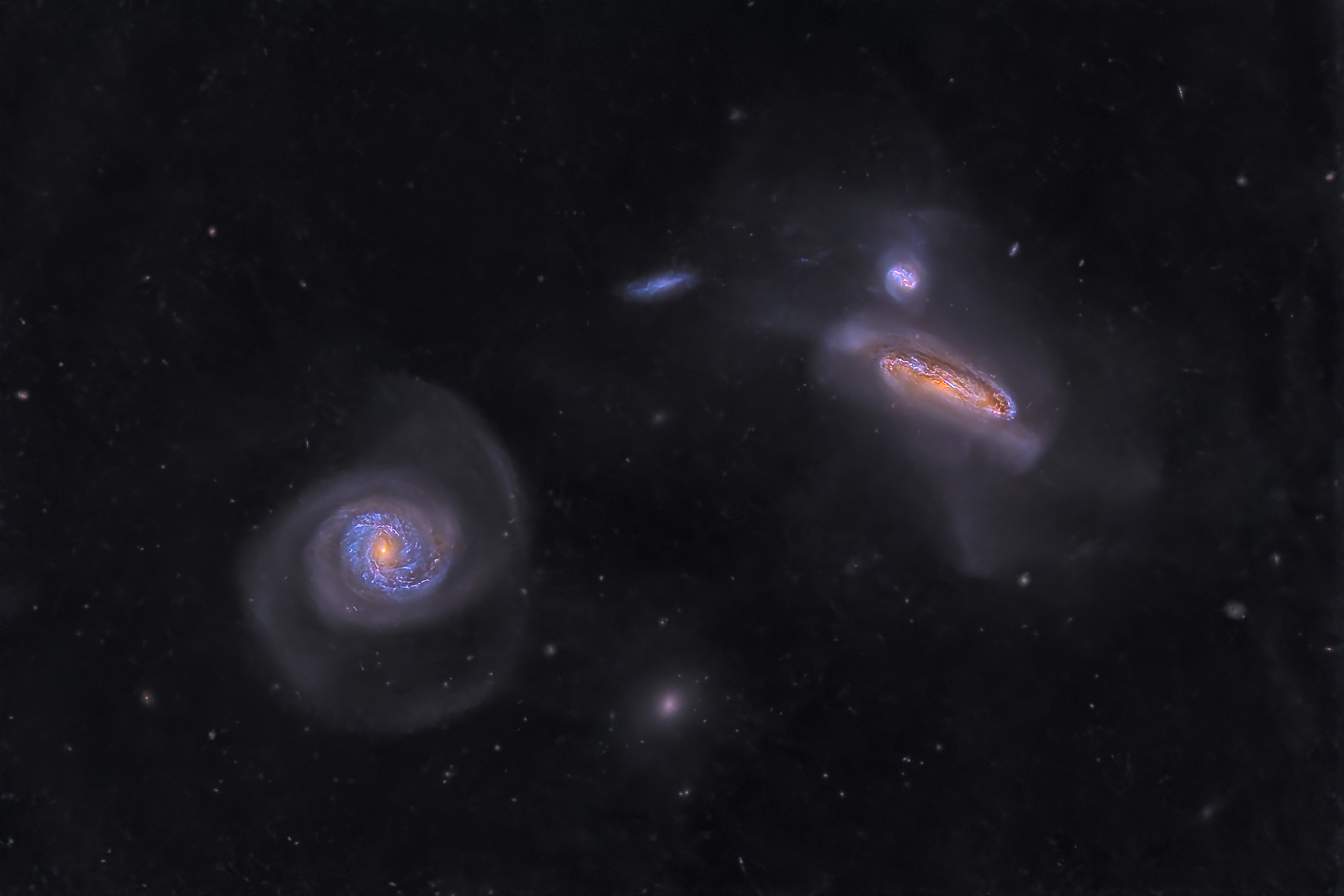
Below Images: The comparison images below present the
same dataset processed using different techniques. The first
version emphasizes the galaxies and their extremely faint tidal
structures by reducing the dense foreground star field and
minimizing the distracting influence of the Milky Way. Hovering
over the image restores the stars and reveals the full field.
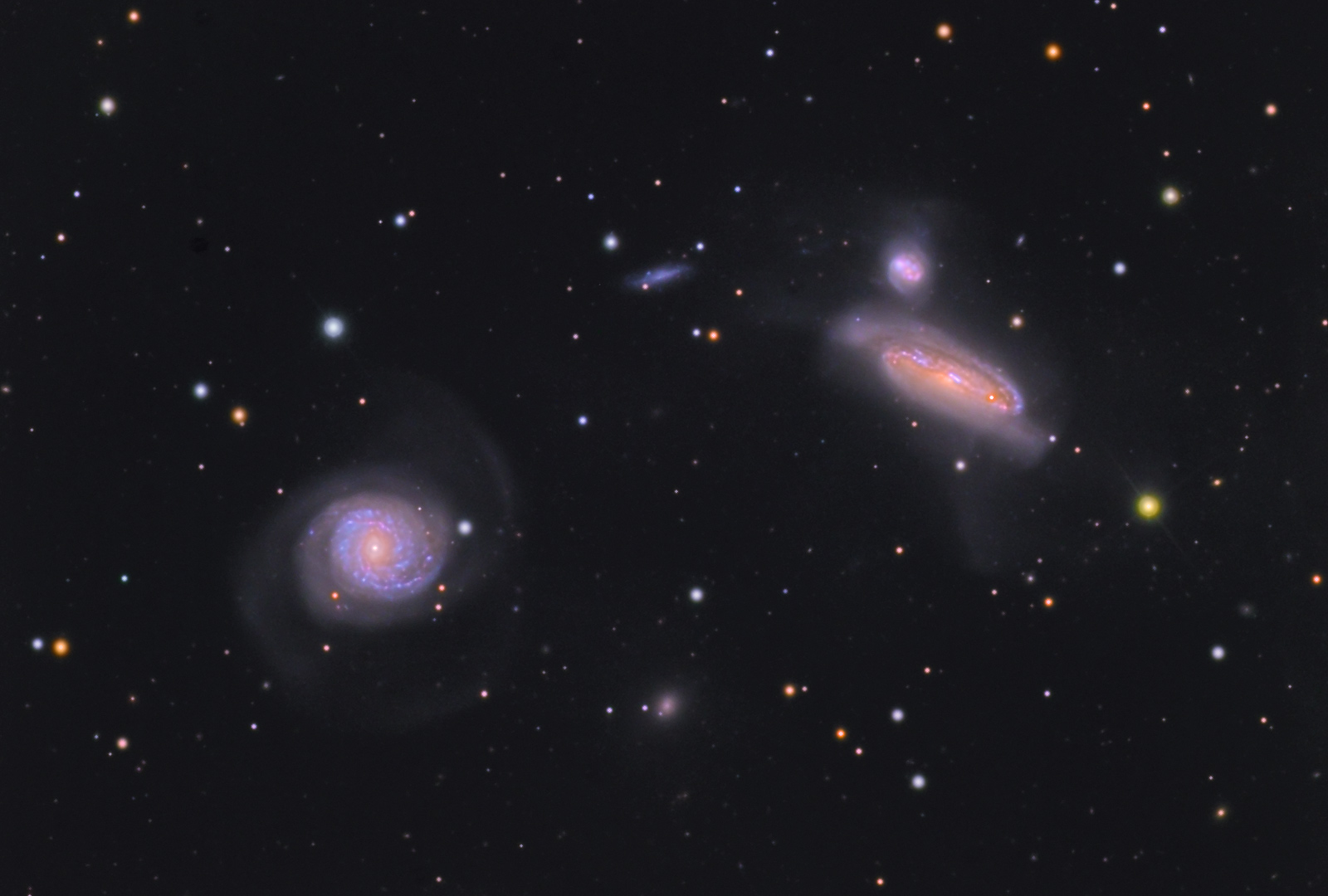
The second comparison image presents the original processing of this image
from 2008 alongside the latest processing,
illustrating how advances in calibration and modern processing techniques can reveal
structures that were barely visible in the original data.
Hovering over the comparison transitions between the two
versions and reveals just how much additional information can be
extracted from the same underlying observations. Finally, further below
is the orginal NASA Picture of the Day images and postings.
Object Statistics: Constellation: Pegasus, Right Ascension:
23
h 51
m 25
s, Declination: +20°
06′ 43″, Apparent Magnitude: ~12.2 (NGC 7771), Distance: ~200
million light-years (~60 Mpc), Principal Members: NGC 7769, NGC
7770, NGC 7771, Additional Possible Members: NGC 7771A, NGC
7786, UGC 12828, Group Catalogs: LGG 483, WBL 726, Holmberg 820,
Morphological Type of NGC 7771: SB(s)a, Recorded Supernovae: SN
2003hg, Large-Scale Structure: Listed in some catalogs as part
of the Virgo Supercluster.
This group of galaxies is likely in the process of merging. NGC
7771 (upper right) is interacting with 2 other visible galaxies.
They will likely merge to form an even larger galaxy. It is also
probable that NGC 7771 will eventually merge with NGC 7769
(lower left) to form a super galaxy of perhaps as many as a
trillion stars. It may be surprising that even with all these
billions stars merging into one galaxy, likely few if any stars
will actually collide with each other due to the vast emptiness
of space. Galactic mergers often cause star formation indicated
by the red regions. Blue regions are hot young stars that have
already formed. Below is the original black and white (luminance
image) for comparison showing the dust regions over processed to
show the amount of material that exists around these galaxies.