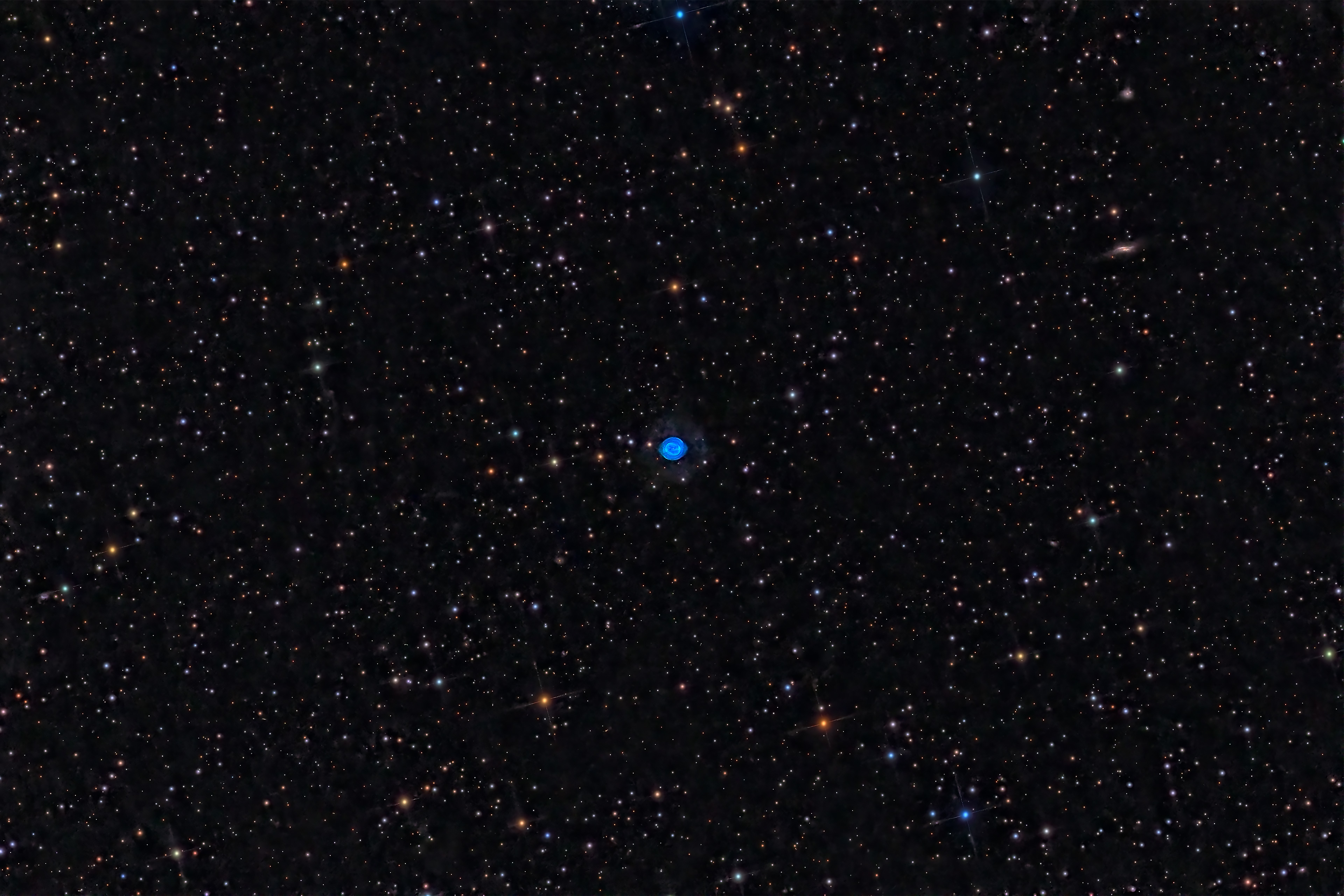
Overview: NGC 2022 is a glowing testament to the final
breaths of a dying star, a cosmic blossom born from stellar
exhaustion and painted across the night in the constellation
Orion — the Hunter. When you gaze upon images of NGC 2022,
whether through the crisp optics of the
Hubble Space
Telescope or in the eyepiece of a modest backyard
instrument, you are not seeing a distant galaxy but the ethereal
shroud of gas and light cast off by a sun‑like star in its death
throes. This is the hallmark of a
planetary nebula: an expanding, glowing shell of ionized gas
that marks the transition of a star from a red giant to a fading
white dwarf, a luminous ghost of its former self.
What It Is: First observed on December 28, 1785 by the great
British astronomer
William
Herschel, NGC 2022 appeared in his telescope as a
“considerably bright, nearly round” object, indistinct but
intriguing — faintly resolved even to his keen eyes. What
Herschel documented centuries ago has since been revealed in
exquisite detail: this planetary nebula is a double‑shell
structure, with an inner, denser layer of glowing gas framed by
a more diffuse outer envelope, both expanding outward into space
as the central star continues its final evolutionary chapter.
A Cosmic Farewell: In the heart of this nebula
lies the star that once powered its brilliance. Over billions of
years, it consumed hydrogen and helium deep in its core, forging
heavier elements until it swelled into a red giant. Eventually,
the star shed its outer layers, and as those gases drifted
outward, the exposed core heated to extraordinary temperatures —
emitting intense ultraviolet radiation that now causes the
surrounding shells to glow with iridescent light. Though called
a planetary nebula, this glowing orb has nothing to do with
planets; the term arises from early telescopic views that made
these objects resemble planets in shape.
Structure
and Dynamics: Modern observations reveal that NGC 2022 is
more than a single, uniform sphere of gas. It displays subtle
structural complexity: a bright inner shell roughly
21 × 17 arcseconds across, enveloped by a larger, smoother outer
layer, and at times a faint extended halo detectable in deep
exposures. These features trace the history of the star’s mass
loss and the physics of gas expanding through the void, slowed
by nothing but the escape velocity of the departing material and
the inexorable march of time. The nebula’s kidney‑shaped
outline, its layered shells, and the interplay of light and
shadow are the result of phenomena such as differing expansion
speeds in the inner and outer gas, the influence of the central
star’s radiation pressure, and the ionization of the ejected
material — all governed by the immutable laws of
physics that
hold the universe in balance.
Observing NGC 2022:
With an apparent magnitude of around 11.6, NGC 2022 is not
visible to the naked eye, but it is a rewarding target for
amateur astronomers under dark skies. Through a small telescope
it appears at first as a fuzzy star, but with careful viewing or
the use of narrowband filters such as O‑III — which isolate the
characteristic greenish glow of ionized oxygen — the subtle disk
becomes more apparent. Large amateur instruments can begin to
hint at the nebula’s double‑shell structure, though the central
star itself, faint and tiny, is a challenge even for substantial
telescopes.
Life After Light: The story of
NGC 2022 is not static; it is a snapshot of stellar evolution in
motion. Over tens of thousands of years, the nebula will
continue to expand and fade as its gas disperses into the
interstellar medium — seeding the galaxy with enriched elements
forged in the furnace of the progenitor star. In this way,
planetary nebulae like NGC 2022 are not endings but transitions,
contributing to the cosmic cycle that will, in time, give rise
to future generations of stars and perhaps even planets.
Annotations. In the image above, hover a mouse or curser
over the image to show annotations of NGC 7727, with several
enlarged insets identifying interesting features! Starting at
the top and left of the image is NGC 4301. Proceeding
counterclockwise is a faint distant galaxy, followed by
enlargements of M61’s spiral arms. Next is another distant
galaxy as well as NGC 4292 mentioned above. Finally is distant
galaxy PGC 213977, too faint and small to be part of the NGC or
Messier catalogues, but large and bright enough to be included
in the PGC catalogue of over 1 million galaxies! Finally, back
at the 12 o’clock position is the central core of M61, showing
its tightly wound arms that extend almost all the way to the
central supermassive black hole.
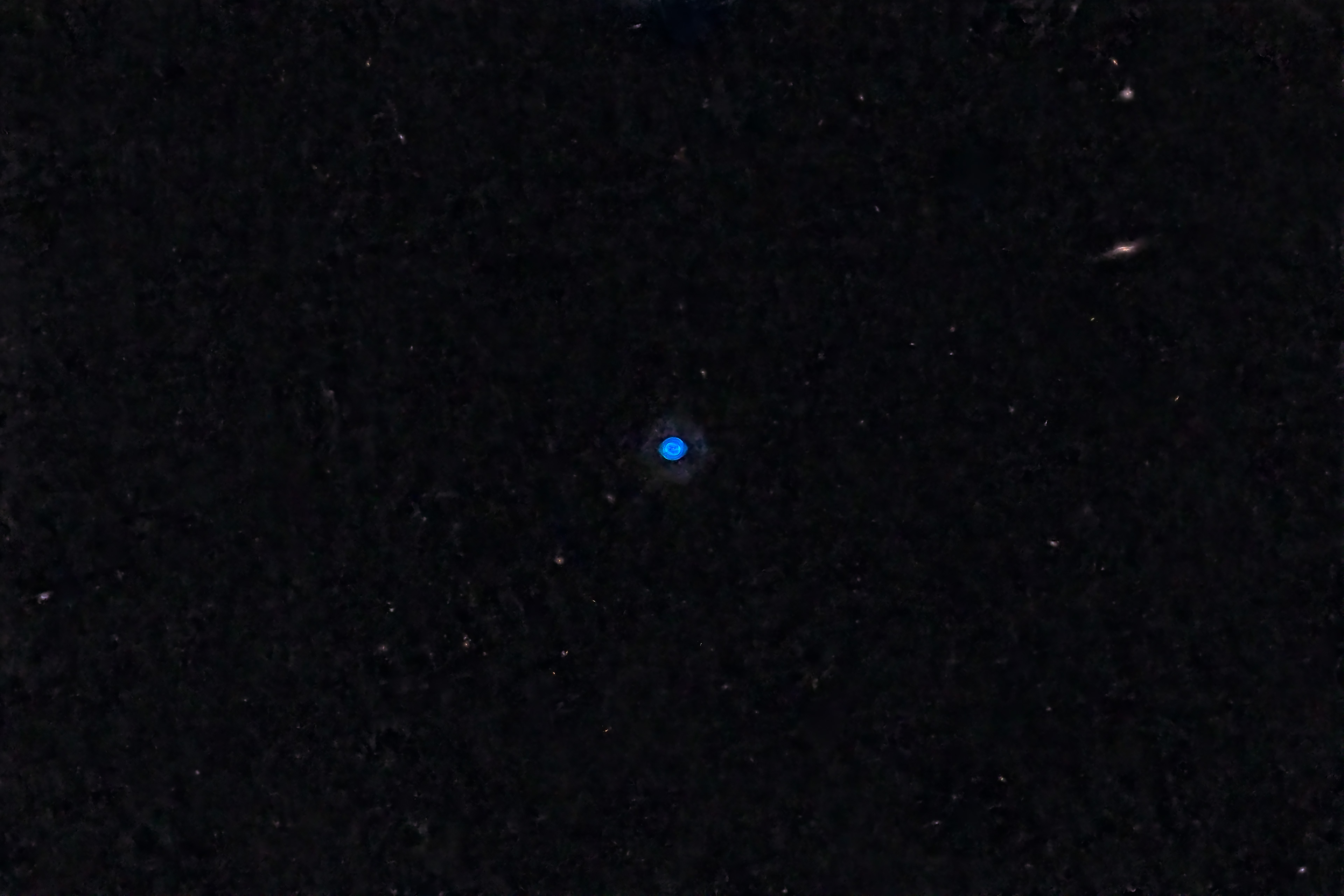
Below is the same image
of M61 but without stars, showing how it would appear
immediately outside our galaxy, since every individual star
visible in the image above is in our own Milky Way Galaxy.
Hovering a mouse over the image brings all the stars back.
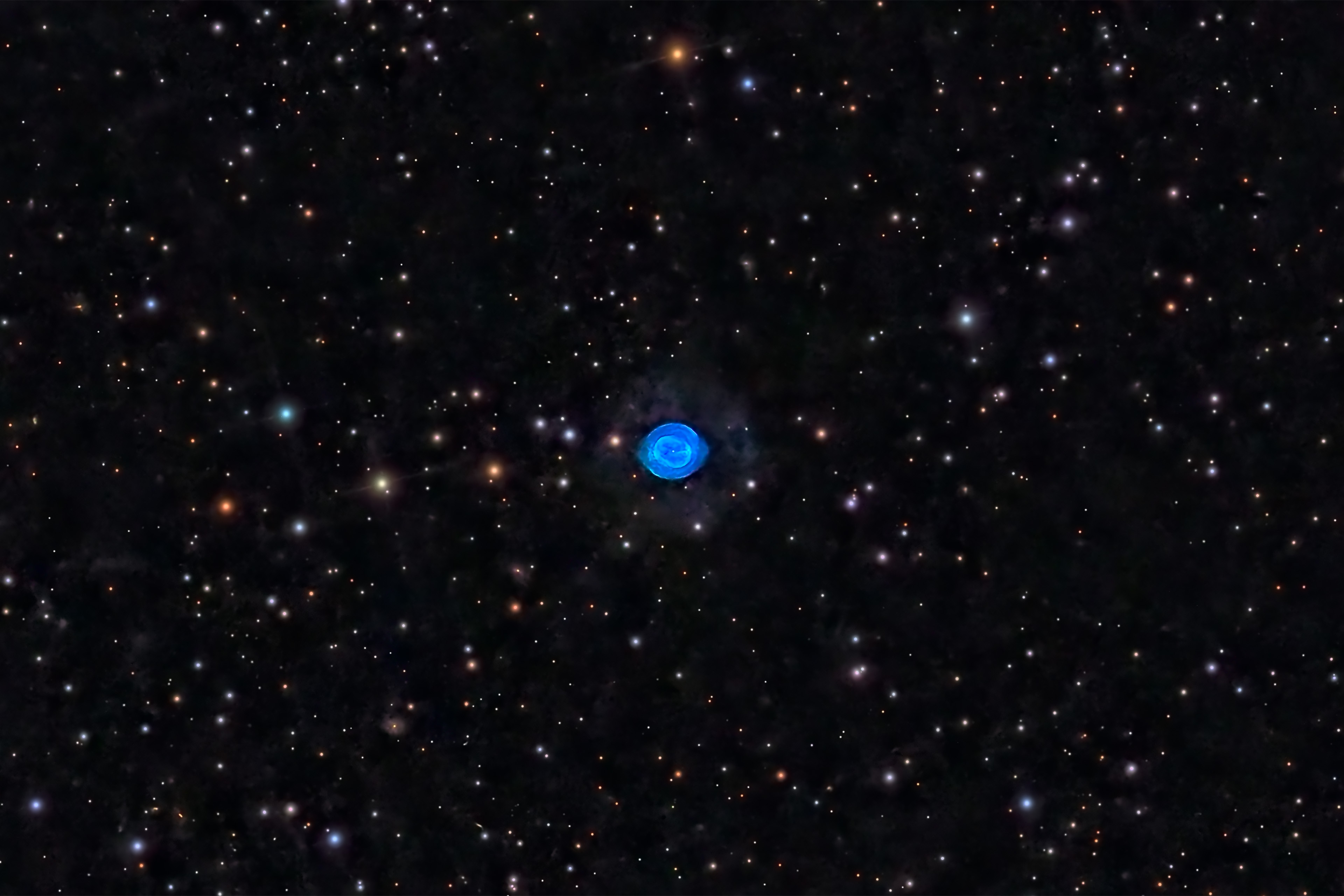
Finally, below is a zoomed in view of only M61 itself. Hovering
a mouse makes that view a starless one as well.
Object Statistics: Constellation: Orion, Right Ascension: 05
h
42
m 06
s, Declination: +08° 22′ 08″
Apparent Magnitude: ~11.6 Angular Size: ~21 × 17 arcseconds
(inner shell) Estimated Distance: ~2,000–2,500 light‑years from
Earth